Buyer Guide
Pool Copings, Treads & Wall Caps: The Edges That Hold a Backyard Together
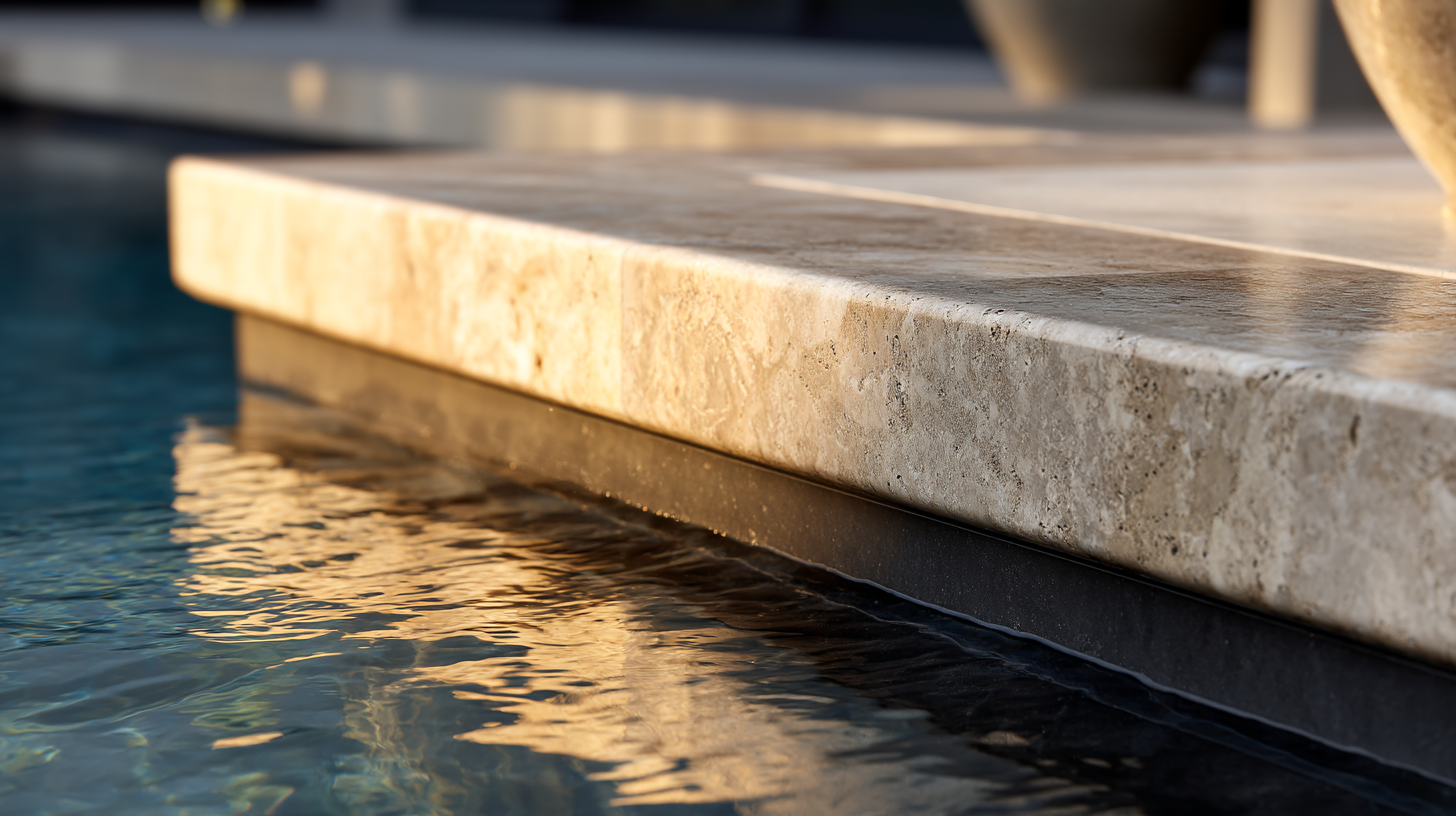
Most backyards live or die at their edges. The patio's stone is what people remember; the coping at the pool, the tread at the stair, and the cap at the retaining wall are what hold the architecture together. Get the field stone right and miss the edges, and the project reads improvised, the eye lands on every transition that doesn't resolve cleanly. Get the edges right, and the field stone reads more considered than it actually is.
This guide covers the three edge categories, pool coping, stair tread, and wall cap, across the 55 colorways in Citadel's coping collection. The material choices, the geometry decisions, and the details that separate an edge that reads designed from one that reads laid.
Pool Coping: The Single Most-Looked-At Edge in the Yard
A pool's coping is the perimeter stone that sits at the top of the pool wall, between the deck stone and the water. It does five jobs: provides a finished visual edge to the pool, gives swimmers a hand-hold and a non-slip exit surface, isolates the deck-stone field from pool-water exposure, sheds water back into the pool rather than into the deck joints, and accommodates the small expansion-joint movement between the rigid pool shell and the more flexible deck system.
Bullnose vs eased vs cantilever
The coping's edge profile shapes how the pool reads visually and how the water meets the perimeter.
Bullnose, a fully rounded edge, half-circle profile, reads traditional, residential, and is the most forgiving of swim-out exits. The water meets the coping in a soft, organic line. Right for traditional and Mediterranean architecture; reads dated in strict modern contexts.
Eased, a slight micro-bevel without full rounding, reads more contemporary. Cleaner geometry, sharper visual line where coping meets water. Right for transitional and modern architecture.
Cantilever (or knife-edge), the coping projects 1 to 2 inches beyond the pool wall and reads as a thin slab floating over the water. The most contemporary profile, the most demanding to install, and the most striking visual result when done well. Right for architectural and contemporary pools where the architecture wants to read minimal.
We dedicate a full guide to the pedestal vs mortar pool deck question and the 2026 pool deck trends that drive these choices.
Material families for pool coping
The 55-SKU coping library covers four meaningful material groups.
Travertine coping, cream, ivory, and warm-tan travertines with honed and tumbled finishes. Reads classical, runs warm underfoot in the sun, and ages with patina. The default for traditional residential pools.
Bluestone and slate coping, warm graphite and natural cleft slate. Reads more contemporary and more architectural; runs hotter than travertine in direct sun (factor it for hot climates).
Granite coping, denser, heavier, more durable. Right for high-traffic and commercial-leaning installations. Reads contemporary; survives anything.
Porcelain coping, Arterra-line porcelain in matched colorways to porcelain pavers, eased rectified edges, the contemporary modern choice. Doesn't develop natural patina; runs cooler than dark stone; the precision of the edge is what makes it read modern.
Drip edge and water resolution
The detail that separates a pool coping that lasts from one that fails: the underside drip edge. The coping should project roughly ¾ inch beyond the pool's tile band, with a small saw-cut groove on the underside (the drip edge) about ¼ inch back from the front edge. Water that runs down the coping face hits the drip edge and falls vertically into the pool rather than wicking back along the underside into the pool wall. Skip the drip edge and the coping concrete back-fill saturates over time, fails the bond, and the coping starts to lift at the corners. It's a 30-second cut at the stone yard that decides whether the coping lasts 5 years or 30.
Stair Treads: The Most-Walked Edge in the Yard
A stair tread is the horizontal stone at the top of each step. The stone takes the foot fall and the wear; the riser below it is usually the same material at a smaller scale or a coordinated softer stone.
Profile choices
Eased rectified, clean micro-beveled edge, contemporary. The default for modern outdoor stairs.
Bullnose, softer, more residential. Slightly safer at the leading edge for bare feet.
Sandblasted top with eased edge, the highest-traction surface, right for any stair that sees wet exposure (pool stairs, exterior front entry stairs in rain climates). The sandblasted finish meaningfully improves slip resistance, see our DCOF and R-rating guide.
Tread thickness
Standard outdoor tread thickness is 2 inches (50mm), substantially thicker than typical paver thickness because the tread spans the void below the riser and takes concentrated foot loads. Thinner treads (1¼ inch / 30mm) work for short rises with continuous support; full-depth 2-inch treads are the residential default for any free-spanning step.
Tread overhang
Treads should overhang the riser by 1 to 1½ inches, the same drip-edge logic as pool coping. Water that hits the tread's leading edge falls clear of the riser face rather than wicking down. The overhang also reads architecturally, a slight shadow line under each tread that gives the stair visual rhythm.
Wall Caps: The Cap Detail That Reads Most Architectural
A wall cap is the horizontal stone at the top of a low retaining wall, planter wall, or freestanding garden wall. The cap sheds water off the wall, provides a finished visual top, and offers an incidental sit-down surface for residential garden walls.
Profile
Wall caps are typically 2 inches thick with eased edges on all four sides, the wall's vertical face below the cap stops at the cap's underside, so the cap reads as a deliberate horizontal projection. The standard overhang is 1 to 1½ inches on the front face (the side facing the patio) and ½ inch on the back (the planting-bed side), creating a slight shadow line that's the cap's main visual signature.
Single-piece vs joint strategy
A short wall cap (under 4 feet) wants a single piece. Longer walls take multiple pieces with seamed joints; the joints should be evenly spaced, color-matched-grouted, and aligned with any stair or planting interruption in the wall below. A cap with random-length joints reads laid; a cap with deliberate, regular joints reads designed.
Coordinating Edges Across a Whole Backyard
The strongest backyards use one or two coping families consistently across all the edge moments, the same travertine at the pool, the same travertine on the stair treads, the same travertine on the planter wall caps. The repetition is what turns the edges into a vocabulary.
The deck field doesn't need to be the same material as the edges. A common premium combination: porcelain Arterra deck pavers in the field with travertine natural-stone coping at the pool, the porcelain handles the field traffic, the natural stone handles the edge details, and the warm-cool contrast between them reads intentional. Or run a natural stone deck with the matching natural-stone coping, the consistency reads classical.
Hot-Climate and Cool-Climate Considerations
In hot climates, dark coping reads beautifully but runs uncomfortably warm in direct sun. Lighter travertines and Arterra's lighter porcelains stay barefoot-friendly through more of the day. In cold climates, freeze-thaw absorption is the deciding factor; porcelain at sub-0.05% absorption never freezes, while denser natural stones (granite, dense quartzite) handle the cycle well. Softer stones (some travertines, limestones) want extra sealing or aren't the right choice for hard freeze climates.
Where to Start
Specifying edges starts with the pool's profile question, bullnose, eased, or cantilever, because it sets the architectural tone for the rest of the yard. From there, the tread and wall-cap profiles want to coordinate, and the material choice flows from the climate and the deck stone. Browse the full coping collection for the 55-SKU library, and pair with the natural stone paver and porcelain paver catalogs for the deck. For the systems-level pool deck question, see our pedestal vs mortar pool deck guide.
Shop the range of copings and edges, and let the flooring and tile coverage calculator convert your room dimensions into a quantity.