Buyer Guide
What Actually Makes a Cabinet Last: Boxes, Hinges and Drawer Runners
Kitchens are sold on doors and they fail on hardware. Nobody replaces a kitchen because they tired of the door profile; they replace it because the drawers sag, the hinges no longer hold alignment, or a sink base swelled after a slow leak. Those are all box and hardware problems, and they are all visible before you buy if you know where to look.
The box
The carcase carries every load in the kitchen. Plywood is the traditional choice and handles moisture better, which matters most in a sink base. Good quality furniture board is flatter, more consistent and perfectly sound in a dry run of cabinets, but it is far less forgiving of a leak.
Two details are worth more than the panel debate. First, how the box is joined: mechanically fixed and glued joints hold square far better than staples alone. Second, the back panel. A thin back stapled on is a box that will rack over time; a substantial back, captured in a groove, is a box that stays square.
Hinges
Ask for three things. Six-way adjustable, so doors can be brought back into alignment as a house settles, and they will need it. Soft close, which is not a luxury so much as a way of stopping the door slamming itself out of alignment over a decade. And a known maker, because in fifteen years you will want a replacement that matches.
A hinge is a few dollars. A kitchen full of doors that no longer sit true is not.
Drawer runners
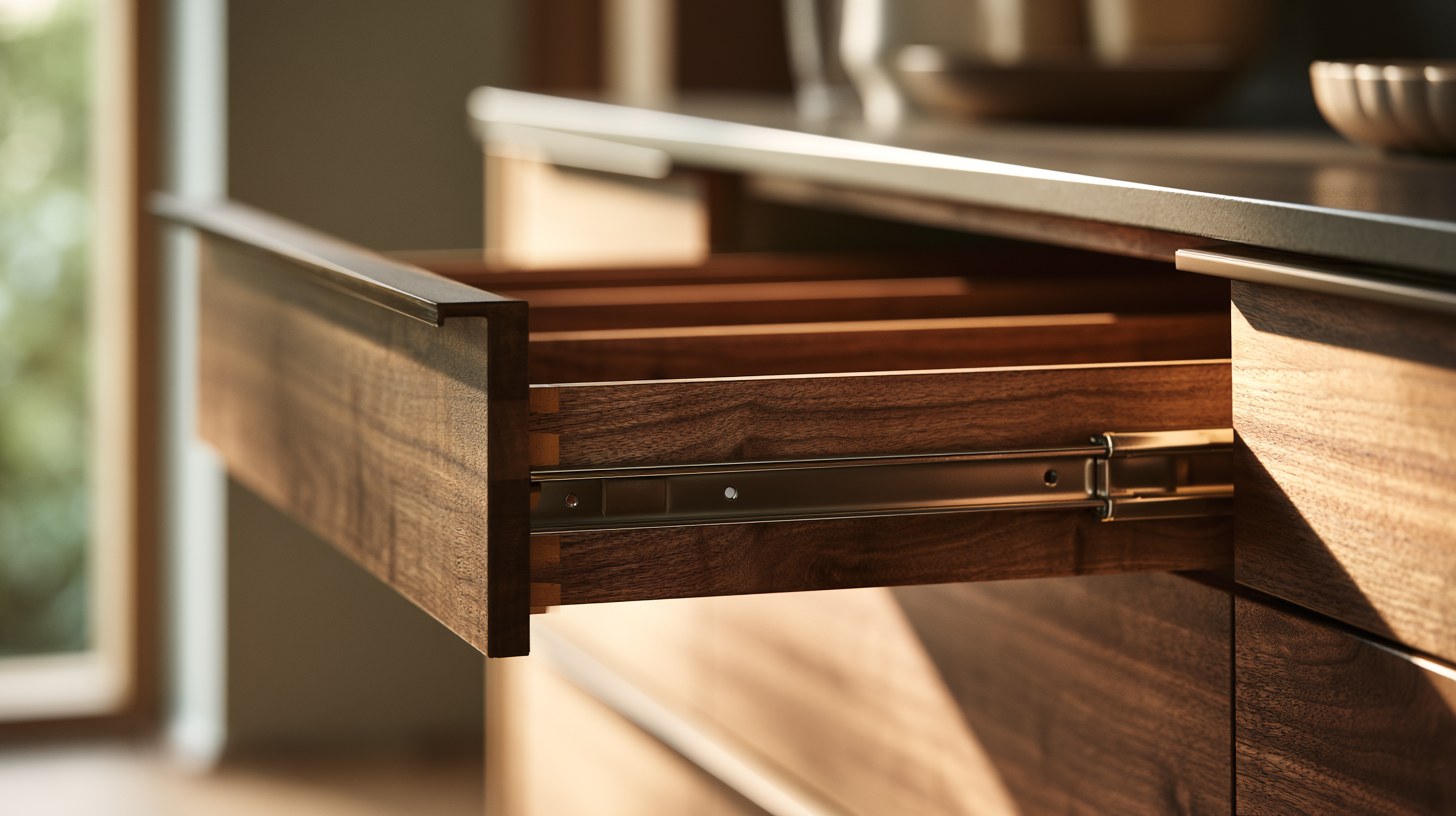
This is where the difference between a cheap and a good kitchen is most obvious to the hand. Look for full extension, so the back of the drawer is actually reachable rather than theoretical. Look for undermount runners, which are hidden beneath the drawer box and both look better and keep debris out of the mechanism. And look at the weight rating, because a pan drawer carries far more than a cutlery drawer and should be specified accordingly.
Open a drawer fully and lean on the end of it. A good runner barely notices.
The parts nobody asks about
Two more, both cheap to get right and expensive to retrofit. Shelf support: metal pins into metal sleeves rather than plastic pins into bare holes, which oval out under load. Finish coverage: check the inside of the box and the back edges, because that is where a manufacturer economises when it is economising.
How to inspect before you commit
Open and close a door twenty times. Load a drawer and pull it out fully. Look inside the box, at the back panel, and at the joints. Ask who makes the hinges and the runners. Ask how long matching parts will remain available, which is the question that decides whether a phased project is possible at all.
Browse framed and frameless cabinets, or read our guide to choosing between the two constructions. Come and open the drawers yourself at 5855 Power Inn Rd, Sacramento, CA 95824.
The five-minute inspection
Run this on any cabinet, ours or anyone else's. It takes longer to read than to do.
- Pull a drawer out fully and lean on the end. A good runner barely notices. This single action tells you most of what you need to know.
- Look inside the box at the back panel and the joints. A thin back stapled on will rack; a substantial back captured in a groove will not.
- Open and close a door twenty times. Listen for the hinge and watch whether the door returns to the same place.
- Check the finish on the inside edges, which is where a manufacturer economises when it is economising.
- Look at the shelf supports. Metal pins into metal sleeves, not plastic into bare holes that oval out under weight.
- Ask how long matching parts stay available. This decides whether a phased kitchen is possible at all.
What fails first, and why
Kitchens are rarely replaced because someone tired of the doors. They are replaced because of these, roughly in the order they arrive.
- Drawer runners sag under pan weight, because a light runner was specified for a heavy drawer.
- Doors drift out of alignment as the house settles, and non-adjustable hinges cannot be brought back.
- A sink base swells after a slow leak nobody noticed for a week.
- Shelf pins oval out and shelves start to sit at a slight angle.
- The finish wears through at the two or three doors that get opened most.
Every one of those is a hardware or box decision made at purchase, which is why the inspection above is worth five minutes.
What this is worth in money
Better hardware is not a large part of a kitchen's cost and it is most of its lifespan. A soft-close hinge is a few dollars. An undermount, full-extension runner rated for a pan drawer is not much more. Across a whole kitchen the upgrade is a modest line on the quote.
Set that against replacing a kitchen five years early because the drawers sagged and the doors would not hold alignment, and it is the least difficult decision in the whole project.
Frequently Asked Questions
Is plywood always better than furniture board? In a sink base, yes. Elsewhere a good furniture board box with sound joinery performs perfectly well.
Are soft-close hinges worth it? Yes, and less for the quietness than for the alignment they preserve over years of use.
Can I upgrade drawer runners later? Sometimes, but undermount runners require a drawer box built for them. It is far cheaper to specify correctly up front.
What is the single best indicator of quality? Pull a drawer out fully and lean on it. That one action tells you most of what you need to know.
Where to Start
Go and open a drawer. Pull it out fully, lean on the end of it, and look at how the box is joined and where the finish stops. That one minute tells you more than any specification sheet. Then browse framed or frameless cabinets knowing what you are looking for, and ask us the five questions above about anything you are considering. Our Sacramento showroom is the easiest place to do it.
Browse cabinets to see the current range, and size your order with the flooring and tile coverage calculator.