Buyer Guide
Turf, Complete: Choosing Between Pile Heights, Densities, and Use Cases
Artificial turf is not one product. It's a category that spans putting-green carpets at half an inch tall to lush lawn-replacement turfs at three inches, with two dozen meaningful permutations in between. Choosing the right one is less about brand than about matching the spec to the actual use case, what the turf is going to do, who's going to walk on it, and how the rest of the yard reads against it.
This guide walks through the four levers that decide which turf is right: pile height, density, blade shape, and color blend. Then we map each combination to the use cases that justify it, and the ones that don't.
The Four Levers That Decide a Turf
Pile height is how tall the synthetic blade reads. Short pile (½ to 1¼ inches) is dense, recovers fast, and reads more like sport turf than lawn. Medium pile (1¼ to 1¾ inches) is the residential sweet spot, long enough to read as grass at viewing distance, short enough to handle traffic. Long pile (2 to 3 inches) reads lush in photos but lays flat under repeated foot traffic.
Face weight / density measures how many ounces of synthetic blade are packed per square yard. Higher numbers mean more blades, more durability, and a fuller read. Quality residential turf typically falls between 60 and 95 ounces. Below 50 ounces, the surface starts looking thin and tired within a season.
Blade shape is the cross-sectional profile of each individual blade. Flat blades are cheap and lay over easily. Diamond, W-shape, and S-shape blades have structural ribs that help the blade stand back up after compression, the difference between a turf that recovers from foot traffic and one that doesn't.
Color blend is the mix of green tones (and sometimes tan thatch fibers) in a single product. A monotone emerald green reads as obviously synthetic. A multi-tone blend with two or three green shades plus a hint of tan thatch reads dramatically more natural, especially under raking sunlight.
Putting Greens and Sport Surfaces
For putting greens, you want short pile (½ inch or less), maximum density, flat blade shape, and a single uniform color. The ball needs to roll true, the surface needs to handle a wedge without tearing, and the visual is supposed to read as a green, not a lawn. The same general spec works for sport practice surfaces and pet-agility courses.
This is the only use case where you want minimum pile height and you want a uniform color, both of which would read poorly in any other application.
Play Areas and Children's Surfaces
For child-focused play areas, the priorities shift to safety and softness. Short to medium pile (1 to 1½ inches), high density, and a foam pad underlayment that provides cushioned fall protection. The foam underlayment is rated to a specific drop-height and is the part that earns the "play turf" designation, without it, you're just installing lawn turf in a play zone and calling it safe.
Color blend should still be multi-tone, children's spaces shouldn't read as obviously synthetic, but durability and recovery weight more heavily here than in any other residential application.
Pet Zones
The dedicated pet-zone spec (covered in depth in our pet turf buyer's guide) calls for medium pile (1¼ to 1¾ inches), high density (60+ ounces), perforated backing for fast urine drainage, and an antimicrobial zeolite infill rather than crumb rubber. Lighter-toned blade blends run cooler in direct sun, a real consideration in any climate that sees full midday heat.
Lawn Replacement (Whole-Yard Turf)
The most common residential application, and the one that most demands a multi-tone, premium-grade product. For lawn replacement, you want medium-to-long pile (1½ to 2¼ inches), high density (75+ ounces), structured blade shape (W or S profile so the pile recovers), and a sophisticated multi-tone color blend with subtle tan thatch fiber.
The single biggest mistake homeowners make in lawn-replacement installs is buying on price and ending up with a too-tall, too-uniform, too-flat pile that lays over the moment it sees real foot traffic. The result reads obviously fake and feels worse underfoot. Spend the money on density and blade structure, not pile height.
Color Blends That Actually Read Like Lawn
Look for products with three to five colors blended at the manufacturing level, not just at the install. Olive green, field green, lime green, and a tan thatch are common; the blend should change subtly across the surface so the eye doesn't catch a uniform tone. The turf collection carries Viridian, Verdura, Summer Gold, Meadow Green Pet Turf, Emerald Precut, and other multi-tone blends specifically designed to read against rather than fight a natural-stone backdrop.
Sub-Base and Drainage
The turf is half the system. The sub-base is the other half. Standard residential install:
- Excavate to 4 inches below finished grade.
- Lay 3 to 4 inches of compacted ¼-inch minus crushed stone (class II road base).
- Top with a thin layer of decomposed granite or coarse sand for leveling.
- Slope the entire pad at minimum 1% away from structures and toward a drain outlet.
- Lay turf, seam, secure to perimeter, and broadcast infill.
Skipping the compaction step is the most common cause of turf installations that develop low spots and pooling within the first year. The base is what carries the surface; the surface only reads as good as the base under it.
Borders and Transitions
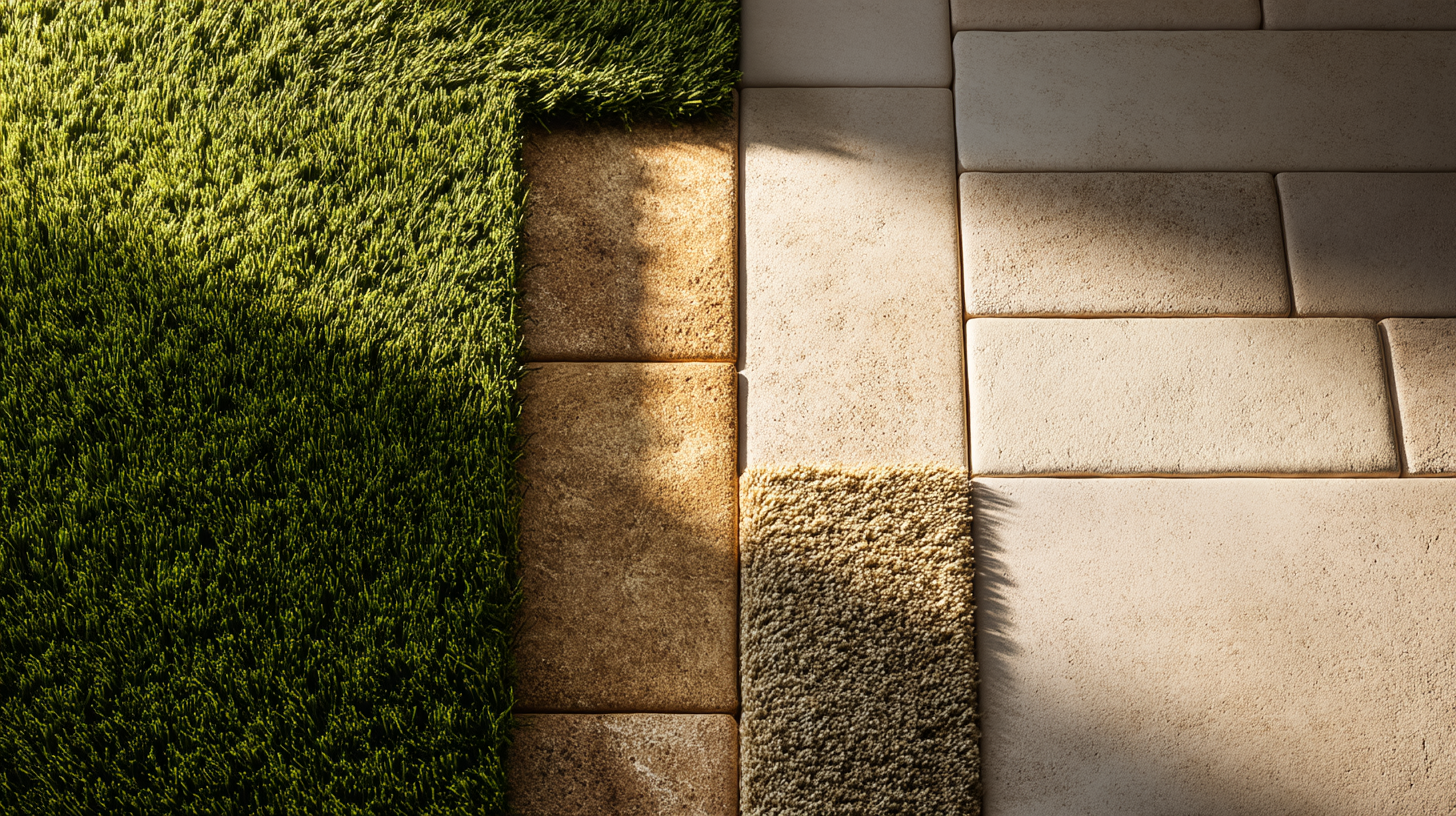
How the turf meets the rest of the yard decides whether it reads intentional or improvised. The cleanest treatments use a soldier-course edge or stone paver border to define the turf zone, with a small drainage gap or polymeric sand joint where the turf meets stone. Bender board and metal edging work too, but they read industrial; in a considered backyard, stone or paver borders read better.
Where turf meets a planting bed, a 4-inch gravel buffer (see decorative gravel options) prevents soil migration into the turf and gives the planting bed a clean visual edge.
Maintenance Across Use Cases
Putting greens want a power broom across the surface every few months to keep blades vertical. Play areas need infill top-up every 3-5 years and a deep clean before winter. Pet zones want weekly rinsing. Lawn replacement turf wants a quarterly brush-up against the pile direction and an annual cleaning.
Across all use cases, fall debris (leaves, pine needles) wants to be removed before winter, left in place, organic matter decays into the infill and creates the kind of gradual surface compaction that shortens turf service life.
Where to Start
The first question isn't which turf. It's which use. Map the yard by zone (pet, play, ornamental, transitional), pick the spec for each zone, and accept that a backyard with two distinct uses likely wants two distinct turf products with intentional borders between them. Browse the turf collection alongside the turf accessories for the infill, seam tape, and edge treatments. For pool-perimeter and outdoor-living context, see our pool deck trends 2026 guide.
Browse turf to see the current range, and size your order with the turf calculator.