Design Trends
Soapstone's Comeback: Designing With a Material That Develops Character
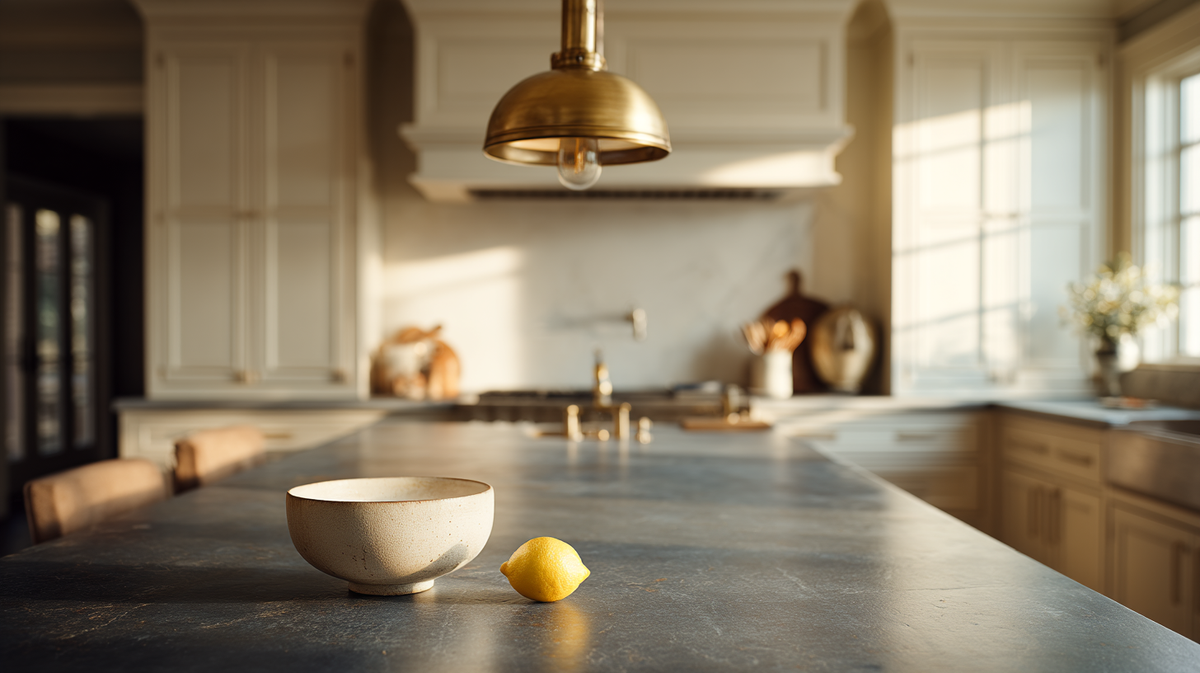
Soapstone had a long quiet stretch in residential. After decades of being the dominant counter material in laboratory and historical-residential applications (the chemistry-classroom counter, the New England farmhouse kitchen), soapstone was largely displaced by granite in the 1990s and quartzite in the 2010s. The 2026 design conversation is bringing soapstone back, and the framing is meaningfully different from its earlier residential use.
This guide explains what soapstone actually is, why it's returning, where it fits in 2026 specification, and the small practical considerations that make soapstone ownership work. For broader patina-context, see our material aging playbook.
What Soapstone Actually Is
Soapstone is a metamorphic rock composed primarily of talc, a soft mineral that gives the stone its characteristic smooth, slightly soapy hand-feel. The talc content varies; "architectural" soapstone for residential use typically has 50-70% talc. The remaining content is various silicate minerals that give the stone its color, durability, and structural stability.
Soapstone's distinctive properties:
- Soft on the Mohs scale (2-3), knives can scratch it
- Heat-immune, soapstone has been used for woodstove construction for centuries
- Chemically inert, no etching from acids, no staining from organic compounds
- Non-porous, water and oil don't penetrate the surface
- Develops patina dramatically with mineral oil treatment
The mineral oil aspect is the soapstone signature. Untreated soapstone is light grey, sometimes with subtle veining. Mineral oil applied to the surface immediately darkens the stone, moving from light grey to deep charcoal-black within minutes. The oil treatment is the soapstone owner's choice; the stone can be kept light or developed dark depending on owner preference.
The 2026 Comeback Drivers
Three reasons soapstone is returning to high-end residential.
The patina-forward direction. 2026 luxury residential is increasingly favoring materials that develop character over time (see our material aging playbook). Soapstone's dramatic patina trajectory, moving from light grey at install to deep oiled charcoal-black across weeks of use, then continuing to develop subtle character over years, is one of the most pronounced patina behaviors in any residential material.
The dark-stone resurgence. Dark counter materials have been gaining residential ground after a decade of white-and-cream marble dominance. Soapstone's deep oiled-charcoal pairs especially well with the warm-cream cabinetry that dominates 2026 kitchens, providing high-contrast visual interest.
The biophilic specification. Soapstone is fully natural geological material with low embodied energy and minimal processing. For projects emphasizing biophilic and sustainable specifications, soapstone is one of the cleaner counter material choices.
Soapstone vs Quartzite vs Slate: The Distinction
Soapstone is sometimes confused with similar-appearing materials.
Soapstone vs slate. Both can read deep grey-charcoal. Slate is harder (Mohs 5-6), heavier-textured, often shows visible cleft surface. Soapstone is softer, smoother to touch, more uniform in appearance. Visually distinguishable on close inspection.
Soapstone vs dark quartzite. Some dark quartzites (Calacatta Quartzite black variants) read similarly. Quartzite is dramatically harder (Mohs 7), shows characteristic veining, doesn't develop the soapstone patina. The "lemon test" works, neither reacts to acid, but soapstone is meaningfully softer.
Soapstone vs honed black granite. Black granite shows the characteristic mineral pattern (small visible grains); soapstone is more uniform. Black granite is harder; soapstone is softer.
The Mineral Oil Trajectory
The soapstone owner's relationship with mineral oil is what makes the material distinctive. The protocol:
At install: The stone may arrive either treated or untreated. Treated soapstone is already deep dark; untreated is light grey.
Initial weeks: Apply food-grade mineral oil generously to the entire surface. The stone immediately darkens dramatically. Reapply weekly during the first month, the stone absorbs more oil during initial treatment.
Ongoing: Apply oil monthly during the first year, then every 2-3 months thereafter. The treatments deepen the patina and maintain the dark color.
If you stop applying oil, the soapstone gradually returns to its lighter natural state over months. This is sometimes intentional, owners who want lighter soapstone can simply skip the oiling. The stone remains functional either way; the oiling is purely aesthetic.
The Care Schedule
Beyond mineral oil, soapstone is one of the lowest-maintenance counter materials.
- Daily care: warm water and mild dish soap, soft cloth
- Avoid: standard "stone care" sealers (soapstone doesn't need them and most are wrong chemistry)
- Acidic spills: harmless, no etching, just wipe
- Hot pans: place directly without trivets (heat-immune)
- Knife marks: occur but are minimized by using cutting boards
One specific consideration: soapstone's softness means dropped objects can chip the edge or surface. Edge chips can be smoothed with fine sandpaper and re-oiled; surface dents typically remain as character marks rather than being repairable.
Knife Marks and the Cutting Question
Knife marks on soapstone are real. The soft surface accumulates fine cuts from direct knife contact. Two responses:
Use cutting boards consistently. The cuts don't accumulate if knives don't directly contact the counter. Most soapstone owners specifically use cutting boards.
Embrace the marks as character. A few knife marks across a soapstone counter at year 5 can read as patina, evidence the kitchen is actually used. Some owners specifically allow this, viewing the marks as part of the material's working-kitchen character.
The first approach preserves the stone's smooth surface; the second produces a more lived-in character. Both are valid; the choice depends on owner preference.
Where Soapstone Earns the Specification
Working kitchens that want patina
The single strongest application. Soapstone develops dramatic character through use; for owners who want their kitchen to read more lived-in over time rather than identical at year 10 to year 0, soapstone is the right counter.
Dark-counter kitchen designs
Soapstone provides the deepest dark-counter option in natural stone (besides specifically-dark quartzites and black granites). For kitchens designed around dark-counter-light-cabinetry contrast, soapstone is one of the strongest choices.
Traditional and historical residential
The historical-residential context (early American, Federal, farmhouse-modern) has soapstone in its native vocabulary. New construction in these architectural directions can specify soapstone as period-appropriate material.
Butler's pantries and secondary kitchens
Where the budget supports premium counter material in secondary spaces, soapstone in a butler's pantry or prep kitchen reads as considered specification. The lower use intensity makes soapstone's softness less of a concern.
Fireplace surrounds and mantels
Heat immunity makes soapstone an excellent fireplace surround material. The dark patinated surface against a fire reads dramatic. See our fireplace surrounds guide.
Where Soapstone Doesn't Fit
Three contexts where soapstone is the wrong specification.
Buyers who want unchanging counters. Soapstone's patina trajectory is the entire point. Buyers who specifically want "looks identical at year 10" should choose quartzite, granite, or porcelain slab, not soapstone.
Households with aggressive cooking patterns and concerns about scratches. Soapstone scratches. For owners who would view the marks as damage rather than character, the softer surface produces frustration. Quartzite (see our quartzite countertops) delivers similar visual range with no scratching concerns.
Outdoor kitchen counters. Soapstone outdoors deteriorates faster than indoor exposure produces. The combination of weathering, freeze-thaw, and use abuse exceeds soapstone's outdoor service capacity. Specify porcelain slab or granite for outdoor, see our outdoor kitchen materials guide.
Pairing Soapstone in a Kitchen
Soapstone's deep dark character is most successfully paired with lighter cabinetry. Specific 2026 strong pairings:
- Soapstone counter + warm cream slim-Shaker cabinetry + warm cream walls + brass hardware (warm-modern interpretation)
- Soapstone counter + warm wood-grain cabinetry (white oak, walnut) + cream walls + brass hardware (warm-rustic)
- Soapstone counter + sage-painted cabinetry + cream walls + brass hardware (cottagecore-modern)
- Soapstone island + lighter perimeter counter (warm marble or quartzite) + light cabinetry (two-tone kitchen with island as character)
The soapstone pairs well with brass hardware (matching aging trajectories, see our unlacquered brass guide), warm wood floors, and the texture-rich Midimalism (see Midimalism guide) and biophilic (see biophilic design 2026) directions.
Where to Start
For homeowners considering soapstone, the immediate questions: are you committed to the patina trajectory, are you comfortable with knife marks as part of the material's character, and does dark counter against light cabinetry suit the architectural direction? If all three answers are yes, browse the soapstone slab collection, the broader countertops and slabs library, and consider the marble slabs as a comparative read for warm patina trajectories. For the broader slab decision, our quartzite vs marble vs granite pillar.
Shop the range of cabinets, and let the flooring and tile coverage calculator convert your room dimensions into a quantity.