Buyer Guide
Quartzite Countertops: The Quiet 2026 Choice
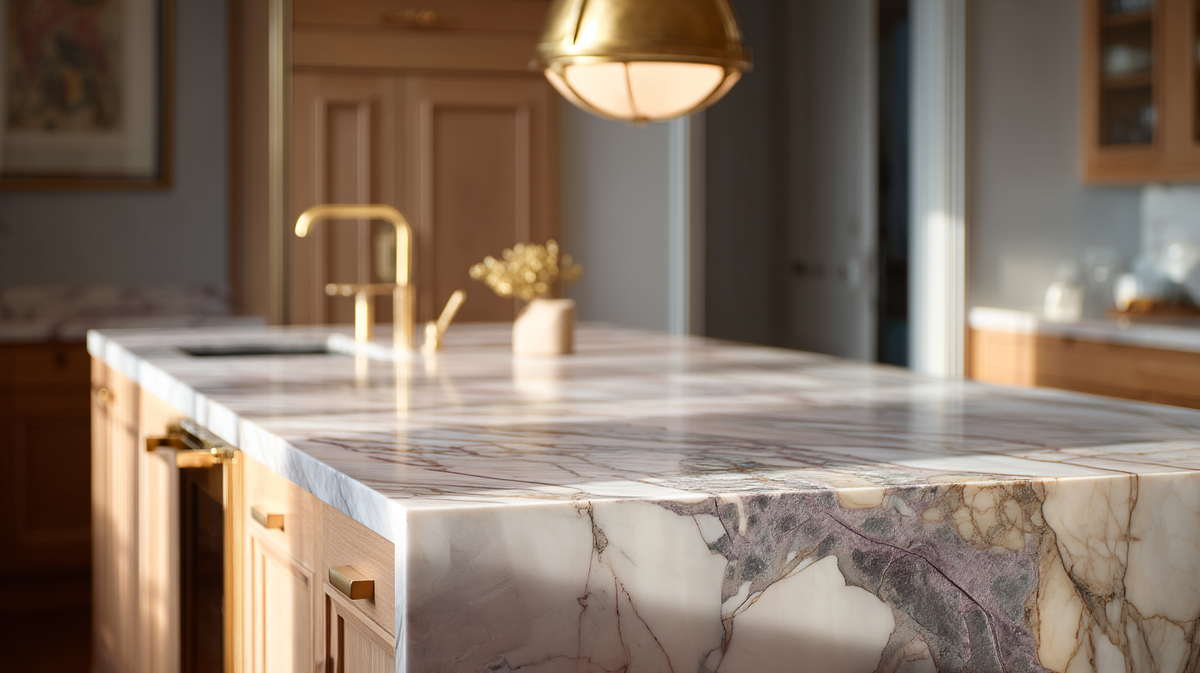
Quartzite has spent the last decade quietly displacing marble at the top of the residential countertop conversation, and 2026 is the year the substitution becomes the consensus. The reason isn't fashion. Quartzite does what considered buyers want marble to do, the dramatic veining, the cool stone hand, the visual weight in a room, without doing what they wish marble didn't: etching from a lemon, scratching from a poorly-handled knife, demanding a sealing schedule that gets forgotten by year three.
This guide reads quartzite closely. What it actually is, how to spot the imposters, where it earns the specification over marble, where marble still wins, and how to specify a quartzite slab without getting burned at the showroom.
What Quartzite Actually Is
Quartzite is a metamorphic rock that begins as quartz-rich sandstone and gets transformed under heat and pressure deep in the earth's crust. The original sand grains recrystallize into an interlocking matrix of quartz crystals, the same material as glass, but assembled in a dense, tight, microcrystalline structure. The result is a stone that scores 7 on the Mohs hardness scale (harder than steel) and is essentially non-porous when properly sealed.
The name "quartzite" gets misused in the trade. Some products marketed as quartzite are actually soft quartzite, a hybrid of quartzite and dolomitic marble that's softer, more etch-prone, and behaves more like marble than like true quartzite. True hard quartzite (Mohs 7) is the version this guide is about. Browse the quartzite slab collection for the curated set.
Hardness, Etching, and the Marble Comparison
Marble is a soft stone (Mohs 3 to 4) made primarily of calcium carbonate. Acidic foods, lemon, vinegar, tomato, wine, react chemically with the carbonate and produce a small dull spot called an etch. Etches don't go away with cleaning; they're a chemical change to the stone surface. They can be repolished out, but the repolishing is a project, not a wipe.
Quartzite, being silicate quartz rather than carbonate, doesn't react to acid. A lemon left on a quartzite counter for an hour leaves no mark. The same lemon on a marble counter leaves a permanent etch within minutes. This single difference is the most important reason quartzite is overtaking marble in working kitchens.
The Mohs hardness also means quartzite resists scratching. A knife dragged across a marble counter leaves a visible scratch; the same knife on quartzite leaves nothing. Most kitchen "knives" cut their cutting boards before they cut the counter, but the durability margin matters in households where the counter actually gets used.
The Color Library
Quartzite's color range is broad in a different way than marble's. Where marble runs cool whites, warm creams, and warm-grey veining, quartzite covers:
White and cream quartzites, Taj Mahal (warm cream with subtle gold veining), White Macaubas (cool white with grey-blue veining), Mont Blanc (warm white with quartz crystal sparkle). The marble-replacement category.
Grey and graphite quartzites, Sea Pearl, Fantasy Grey, Calacatta Quartzite. Reads cooler and more contemporary than the cream family.
Dramatic veined quartzites, Patagonia, Azul Macaubas, Ocean Storm. The "statement slab" category, large-scale veining or color movement that makes a single slab the focal point of a kitchen.
Warm and earthy quartzites, Sequoia, Cristallo Tiffany, Iceberg. Browns, golds, and warm earth tones; pairs especially well with warm cabinetry and traditional architecture.
Browse the full quartzite slab collection or step up to the complete countertops and slabs library for the comparative read across material families.
Where Quartzite Edges Out Marble
In a working kitchen with daily cooking, kids, dinner parties, and the small acid spills that come with all of those, quartzite is the right call. The behavior is more forgiving, the maintenance is lower, and the visual still reads as natural stone (not as engineered material). Most considered residential buyers in 2026 are choosing quartzite for the kitchen and reserving marble for the spaces where they actually want the patina trajectory: bath vanities, fireplace surrounds, accent tables.
Where Marble Still Wins
Two cases. First, the buyer who specifically wants the patina, the small etches and tonal softening that turn a marble counter at year 10 into a more beautiful object than it was at year 1. That's a real aesthetic argument and the right answer for some buyers; the etch isn't a flaw if you wanted it. Second, projects where the marble's specific colorway can't be matched by any available quartzite, Calacatta Borghini's specific veining, certain warm Crema Marfils, the most classical Italian whites. We cover the comparative read in our sintered stone vs natural quartzite guide.
Sealing and Care
True hard quartzite wants a penetrating stone sealer applied at install and reapplied every 2 to 3 years. The sealing is meaningfully simpler than marble's because the stone is less porous to begin with, the sealer is doing prevention rather than constant defense.
Daily care: pH-neutral stone cleaner or simply warm water with a microfiber cloth. Avoid acidic cleaners (lemon, vinegar) on any natural stone counter, including quartzite, even though quartzite resists acid, the sealer doesn't, and acidic cleaners shorten the sealer's life.
The sealing-test for any quartzite slab: drop water on it. If the water beads up, the sealer is intact. If the water spreads and darkens the stone, it's time to re-seal. Repeat the test at year 2; in most kitchens, the re-sealing interval is between 18 months and 4 years depending on use intensity. We cover the full sealing protocol in our sealing natural stone guide and the long-term care specifics in our caring for quartzite countertops piece.
Slab Selection: How to Avoid Getting Burned
The single biggest pitfall in quartzite buying is the soft-quartzite confusion, paying premium-quartzite prices for a slab that behaves like marble. Three protections:
First, ask for the specific quartzite name and confirm the source quarry. Real hard quartzite has a documented origin; soft quartzite often has vague provenance.
Second, request a sample chip and do the lemon test at home, drop a slice of lemon on it for 15 minutes and wipe off. No mark, true quartzite. A faint dull spot, soft quartzite.
Third, work with a curator rather than a slab yard alone. The slab yard is selling you a slab; a curator is responsible for whether the slab does what they said it would. We do the soft-quartzite vetting before slabs hit our catalog; that's the standard.
Pairing Quartzite in a Kitchen
Quartzite's veining tends to read more dramatic than marble's. The kitchen architecture should give the slab room to breathe. That usually means simpler cabinetry, slim Shaker or flat-front in a quiet finish (see our cabinet decision guide), low-pattern flooring (Nove or hardwood, see our Nove curator guide), and minimal contrast in the backsplash so the counter remains the visual anchor.
For a contemporary kitchen, pair quartzite with frameless flat-front cabinetry, unlacquered brass hardware (see our unlacquered brass piece), and a porcelain slab backsplash from our porcelain slab catalog that quiets down rather than competes with the counter.
Where to Start
Quartzite shopping starts with the slab, not with a sample chip. The slab's specific veining and color movement is what you're buying, two slabs of the same colorway can read meaningfully different. Browse the quartzite slab collection for the curated set, and step up to the broader countertops and slabs library to compare quartzite against quartz, marble, and porcelain in the same project read. For the full slab decision tree, see our quartzite vs marble vs granite buyer's guide.
Ready to compare in person? Browse quartzite slabs at Citadel Spaces, and use the countertop and slab calculator to turn room dimensions into an order quantity.