Buyer Guide
Unlacquered Brass: When Hardware Gets Better With Age
For most of the past two decades, residential brass hardware has been the lacquered version, a clear protective coating sealed over the brass surface to prevent the natural oxidation that produces patina. The lacquer keeps the hardware looking mirror-perfect indefinitely, which is what most homeowners seemed to want.
That preference is reversing. The 2026 design conversation is increasingly enthusiastic about unlacquered brass, solid brass without the protective coating, which oxidizes naturally over time and develops the warm, slightly tarnished patina that reads as authentic luxury rather than as new-construction. The aged brass is now what many premium projects specifically want.
This guide explains what unlacquered brass actually does over time, when to polish, when to let it age, and how to specify the hardware that develops the right kind of patina rather than the wrong kind.
Lacquered vs Unlacquered: The Quick Distinction
Both products are typically solid brass underneath. The difference is the surface treatment.
Lacquered brass has a clear protective coating sealed over the polished brass surface. The coating prevents oxygen and moisture from reaching the brass, which prevents the chemical reactions that create patina. The hardware stays mirror-bright indefinitely. When the lacquer eventually fails (5-15 years depending on use), the underlying brass starts oxidizing irregularly through the failure points, producing a splotchy "ruined" look.
The lacquer also gradually yellows and dulls with UV exposure and use, so even before failure, lacquered brass slowly looks less crisp than at install.
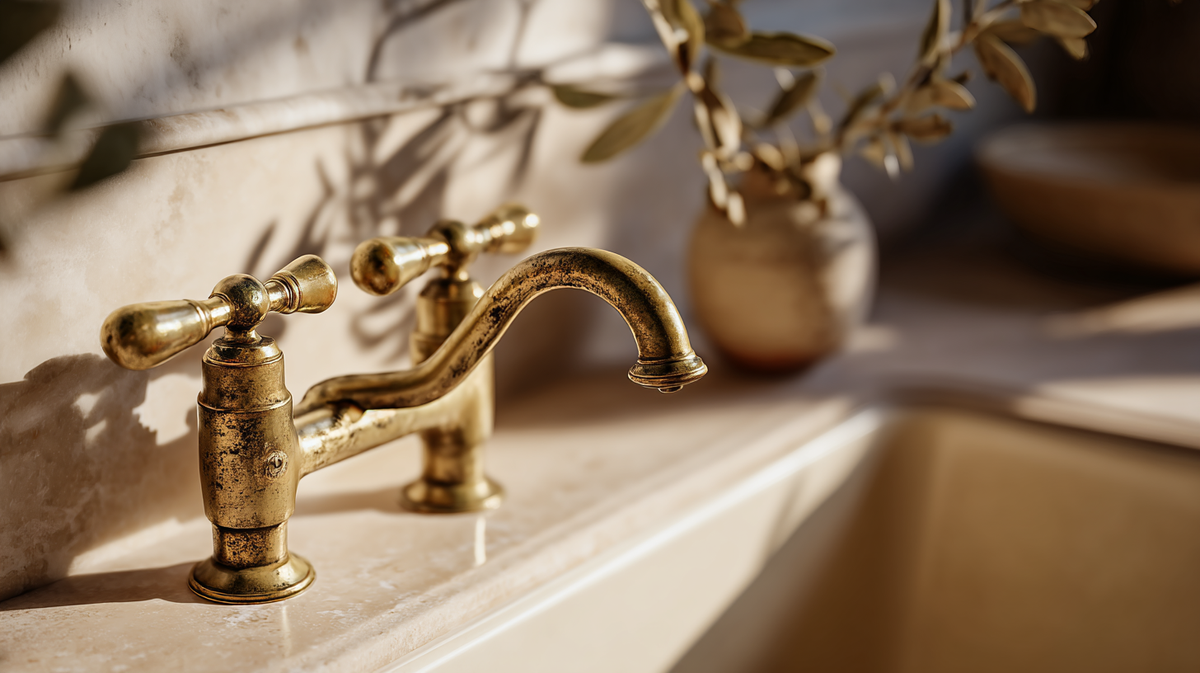
Unlacquered brass has no protective coating. The brass surface is directly exposed to air, water, oils from skin, cleaning products. Within months it begins developing patina, a darkening and warming of the surface as copper-and-zinc compounds form. Across years, the patina deepens. The hardware develops character.
The Patina Timeline
The timeline of unlacquered brass patina varies with humidity, hand contact frequency, and chemical exposure, but a typical residential trajectory:
Months 1-3: Bright polished brass, with subtle warming. Most-handled spots (faucet handles, drawer pulls in the kitchen) start showing slight darkening from skin oils.
Months 4-12: Distinct two-tone read between most-handled areas (warming toward the unlacquered "honey" color) and less-handled areas (still bright). The contrast is the hardware's first character.
Years 1-3: Overall patina deepens. The "honey" color extends across the hardware. Most-handled areas show slight patina depth that reads as "this is being used."
Years 3-7: Mature patina. The hardware reads as established luxury. The character is fully developed and the appearance is essentially stable.
Years 7+: Very stable patina with subtle deepening. At this point, the hardware looks essentially like an antique brass piece, warm, deep, settled.
Hard-Water and Climate Effects
Patina behavior varies by environment. Three factors affect the trajectory.
Water chemistry. Hard water (high mineral content) accelerates patina; soft water slows it. Sacramento Valley water is moderately hard; expect medium-paced patina development.
Humidity. Higher ambient humidity accelerates patina. Bathroom hardware patinas faster than living-room hardware in the same house. Coastal homes patina faster than inland homes.
Cleaning chemistry. Aggressive cleaners (vinegar, ammonia-based, abrasive cleaners) can strip patina mid-development, producing splotchy uneven results. The cleaning protocol affects patina more than most owners realize.
When to Polish, When to Let It Age
The single most-asked question about unlacquered brass: when do I polish it?
The honest answer for most owners: rarely. The polished bright brass that polish produces is the "before" state. It's what the hardware looked like at install. Polishing returns the hardware to that state and restarts the patina clock. For owners who specifically want the bright polished look, regular polishing makes sense. For owners who want the patina, polishing undoes the desired aging.
Specific cases where polishing might still be worth doing:
- Specific spot rescue. A small splotchy area from a chemical spill or aggressive cleaner can be polished out, allowing the area to re-patina along with the rest.
- Show-house preparation. Selling the house and want the brass to look "newer" rather than "aged"? Polish before listing.
- Year-1 reset. Some owners polish at year 1 to start the patina trajectory cleanly with consistent surface chemistry, then let the hardware age uninterrupted thereafter.
For most owners committed to the patina aesthetic, the answer is just to let the hardware age. The patina IS the point.
Daily Care
The right care regimen for unlacquered brass is light:
- Wipe with a soft dry cloth occasionally to remove water spots
- For more thorough cleaning, mild soap and water, dried thoroughly
- Avoid acidic cleaners (vinegar, lemon, ammonia)
- Avoid abrasive cleaners or scouring pads
What to specifically avoid: brass polish products on hardware that you're letting patina. The polish removes patina; if patina is the goal, polish is the enemy.
Pairing Unlacquered Brass in a Kitchen
Unlacquered brass pairs best with materials that share its time-trajectory, materials that develop character over years rather than staying static.
- Natural stone counters, marble, quartzite, soapstone develop patina alongside the brass. See our slab buyer's guide and soapstone comeback.
- Hardwood floors, wood patinas alongside brass. The combination reads as integrated material time.
- Wood-grain or wood-tone cabinetry, see our cabinet decision tree.
- Stacked stone veneer fireplace surrounds, natural stone reads warm against warm brass.
- Linen and natural-fiber textiles, texture pairs with character.
Unlacquered brass pairs less well with strict-contemporary contexts that want unchanging materials throughout. In those settings, the brass's time trajectory disconnects from the rest of the architecture's static read.
Where to Specify Unlacquered Brass
The strongest 2026 applications:
Kitchen faucets
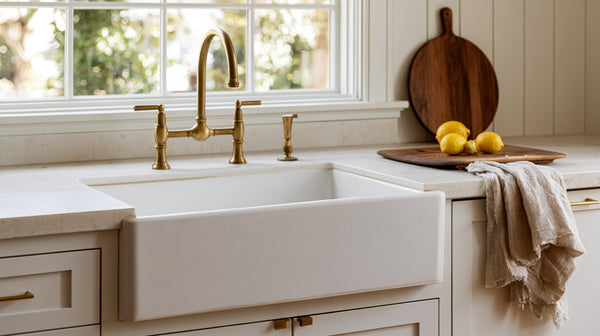
The most-handled hardware in the house. Daily contact accelerates patina at the most-touched zones, creating natural two-tone character. Browse the kitchen faucet collection for unlacquered brass options.
Bathroom faucets and accessories
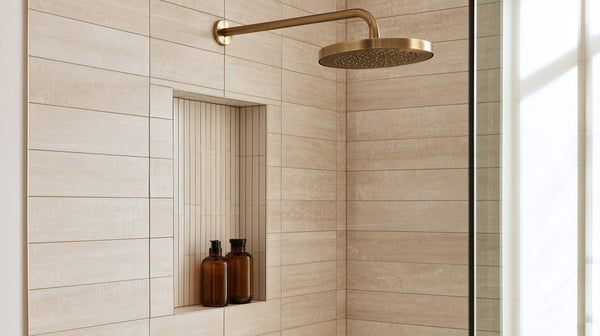
Higher humidity accelerates patina. Coordinated unlacquered brass, faucets, drain, towel bars, robe hooks, reads as architectural language across the bath. See bathroom faucets and tub and shower faucets.
Cabinet hardware
Pulls and knobs across kitchen and bath cabinetry. The patina develops fastest at most-handled drawers (silverware, daily-use cabinets), creating natural use-pattern character.
Lighting fixtures
Pendants, sconces, and chandeliers in unlacquered brass develop patina more slowly than hardware (less direct contact) but still age into character. Strong specification for warm-modern interiors.
Architectural details
Door handles, hinges, and architectural brass develop patina across years and ground the architecture in time.
Where Unlacquered Brass Doesn't Fit
Three contexts where lacquered or alternative hardware is the better choice.
Strict-contemporary cool palettes. Unlacquered brass's warm character reads warm; cool-modern interiors that want everything to read static and cool may prefer lacquered, brushed nickel, or matte black hardware.
Commercial and rental applications. Where multiple users have access and the ownership doesn't have a long-term patina vision, lacquered hardware delivers consistent appearance without depending on owner habits.
Aggressive-cleaning households. Households that bleach-clean, use harsh kitchen cleaners, or aggressively polish surfaces will fight the patina rather than working with it. Lacquered hardware is more forgiving of aggressive cleaning.
Verifying You're Getting Real Brass
One specification care: cheaper "brass" hardware is sometimes brass-plated (a thin brass coating over a different base metal) rather than solid brass. Brass-plated hardware doesn't patina the same way, when the plating wears, the underlying base metal shows, producing splotchy results that look like damage rather than character.
Verify solid brass at specification. Solid brass is significantly heavier than plated alternatives (a hand-feel test is reasonably reliable). Quality manufacturers specify "solid brass" or "100% brass" explicitly; vague specifications ("brass finish," "brass plating") usually indicate plated rather than solid.
The Patina Philosophy
The case for unlacquered brass is broader than aesthetics. The hardware develops character with the house, accumulating use-patterns and time. Year-10 brass tells you the kitchen has been cooked in. Year-20 brass tells you the home has been lived in. The hardware becomes part of the house's story rather than staying frozen as new-construction.
This is the same philosophy that drives premium natural stone, hardwood, and other character-developing materials. We cover the broader aging trajectory across material families in our material aging playbook.
Where to Start
For owners committed to the patina aesthetic, unlacquered brass is the strongest hardware choice currently available. Browse kitchen faucets, bathroom faucets, and tub and shower faucets for the unlacquered options. For pairing context, see our cabinet decision tree, quartzite countertops, and Midimalism guide.
Ready to compare in person? Browse kitchen flooring at Citadel Spaces, and use the flooring and tile coverage calculator to turn room dimensions into an order quantity.