Buyer Guide
Caring for Quartzite Countertops: A Long-Term Guide
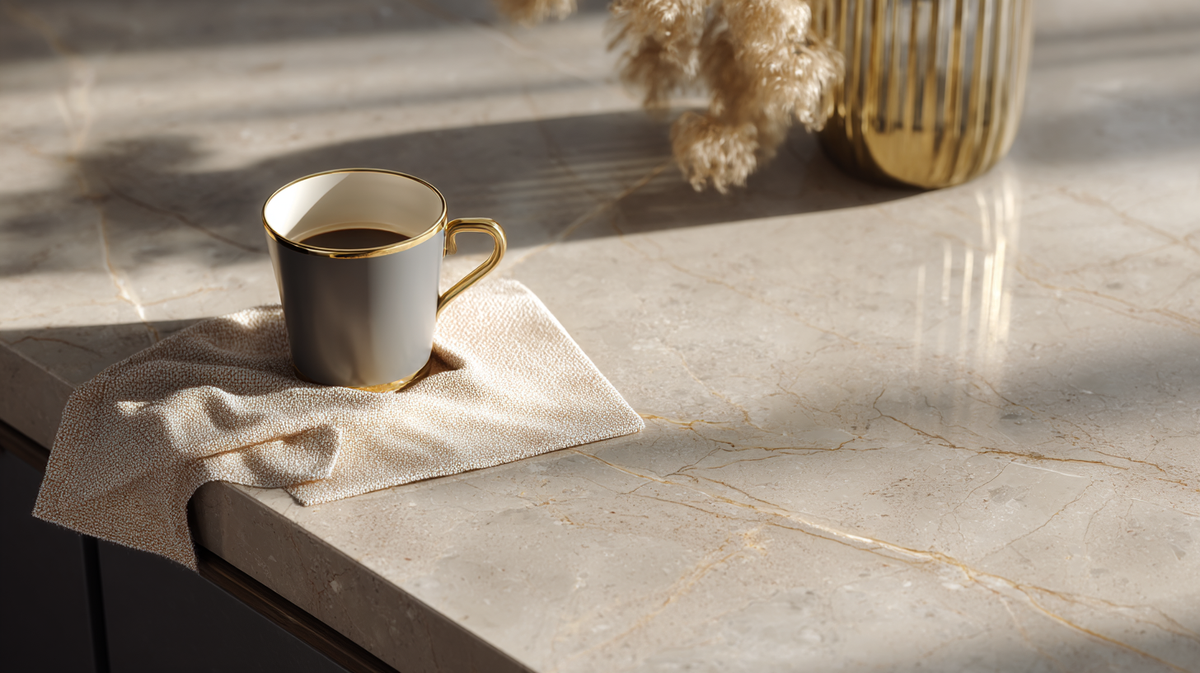
Quartzite is one of the most forgiving natural-stone counters available, harder than marble, less porous than travertine, less reactive to acids than calcium-carbonate stones. The maintenance schedule is meaningfully lighter than most homeowners expect. But "lighter than expected" still isn't "none," and the small care details that keep a quartzite counter looking premium across a decade are worth getting right from the start.
This guide walks through the long-horizon care for quartzite, the schedule, the products, the daily habits, and the small mistakes to avoid. For the broader material context, our quartzite countertops 2026 spotlight and the quartzite slab collection.
The Sealing Schedule
True hard quartzite wants a penetrating stone sealer applied at install and re-applied every 2 to 3 years thereafter. The interval is meaningfully longer than marble (1-2 years) because quartzite's lower porosity means the sealer is doing prevention rather than active defense.
The water-bead test confirms whether the sealer is still working: drop a few drops of water on the counter and watch. If the water beads up tightly on the surface, the sealer is intact. If the water spreads into a flat film and starts darkening the stone, it's time to re-seal.
Run the test annually. In most kitchens, the re-seal interval lands at 2 to 3 years; in light-use kitchens it can extend to 4 years; in heavy-use commercial-residential it shortens to 18 months. We cover the broader sealing protocol in our sealing natural stone guide.
Daily Cleaning
The right daily cleaning regimen:
- Warm water and a soft microfiber cloth for routine wipe-downs
- pH-neutral stone cleaner for spot-cleaning and end-of-day cleaning
- Mild dish soap for occasional grease cleanup
The cleaner you use directly affects how long the sealer lasts. Using the wrong chemistry, even just once, can strip sealer in concentrated areas and leave the stone underneath vulnerable for the rest of the sealing cycle.
What to Keep Off the Counter
Acidic cleaners. Vinegar, lemon-based cleaners, ammonia, citrus-based cleaners. These strip sealer rapidly. Even though true hard quartzite resists acid etching, the sealer doesn't, and acidic cleaners shorten the sealer's effective life.
Bleach and bleach-based cleaners. Strip sealer and can affect surface appearance over time.
Abrasive cleaners. Comet, Bar Keepers Friend, scouring powders. Physically damage the sealed surface.
Generic "all-purpose" cleaners. Most contain chemistry that's wrong for natural stone. Read labels; if it doesn't specifically say "stone safe" or "pH neutral," it probably isn't.
Scouring pads and abrasive sponges. Physical abrasion that damages the sealed surface and can gradually dull polish.
Heat: What's Actually True
Quartzite handles heat better than marble or engineered quartz, but it's not heat-immune. Direct contact with very hot pans (over 400°F) can cause thermal stress that produces hairline cracks, especially at edges and seams.
The right protocol: trivets under hot pans, just like with marble. The trivets are protecting against the small risk of thermal stress damage rather than against staining (sealer handles staining). For most residential cooking, hot pots from the stove, occasional baking dish from the oven, quartzite handles it without trivets just fine. The trivet habit is the cheap insurance against the rare thermal-stress event.
Cutting and Knife Behavior
Quartzite is harder than steel knives. Cutting directly on quartzite doesn't damage the stone; it dulls the knife. This is genuinely true and counter-intuitive for buyers conditioned to "always use a cutting board."
The reason most homeowners still use cutting boards: knives are cheaper than counters even when the counter doesn't damage. Letting your kitchen knives dull through direct counter contact means more frequent sharpening and replacement. The cutting board protects the knife edge.
That said: the occasional accidental knife scrape on quartzite produces no visible mark on the stone. This is the practical advantage that quartzite has over marble in working kitchens, small kitchen accidents don't accumulate visible damage.
Spills and Stain Prevention
Sealed quartzite doesn't stain from common kitchen spills, wine, coffee, oil, beet juice, provided the spill is wiped within a reasonable time (15 minutes to an hour). The sealer prevents penetration during that window. After several hours, even sealed quartzite can absorb some pigment in heavily-stained materials.
The right habit: wipe spills as you notice them, but don't panic if a spill sits for an hour. The sealer is doing its job.
Stains that do penetrate (rare with proper sealing) can usually be lifted with a poultice, a paste of baking soda and water applied to the stain, covered with plastic wrap, and left for 24-48 hours. The poultice draws the absorbed pigment back to the surface. Most quartzite stains can be removed this way; for severe stains, professional stone restoration may be needed.
Polish Care
Polished quartzite (high-gloss factory finish) shows water spots and fingerprints more visibly than honed quartzite. Most polished stone wants daily wipe-down with a soft cloth to prevent water spotting.
Honed quartzite (matte factory finish) hides water spots and fingerprints better. Slightly more forgiving in daily use; most homeowners with polished kitchens eventually wish they'd specified honed.
For both finishes, polish wear over years (especially around sinks where water exposure is constant) is normal. Professional re-polishing is available if the wear becomes objectionable; most homeowners accept the gradual softening as part of the stone's character.
The Soft-Quartzite Watch
One specific care risk: if your "quartzite" is actually soft quartzite (the marble-quartzite hybrid that some sellers misrepresent), the care protocol is different. Soft quartzite etches from acidic spills, behaves more like marble, and wants the more aggressive marble care schedule.
Test: drop a slice of lemon on the counter for 15 minutes and wipe off. No mark = true hard quartzite, follow this guide. A faint dull spot = soft quartzite, follow marble care protocol from our marble tile guide.
Long-Term Polish and Patina
Across 10-20 years, quartzite changes only minimally. Slight polish softening at heaviest-use zones (around the sink, the central work area), perhaps a few invisible micro-etches if the stone happened to be soft quartzite, occasional deep-set spot stains if a spill went unnoticed for hours.
This is one of the differentiators between quartzite and marble: marble develops visible character over decades that some buyers love and others don't; quartzite stays essentially unchanged. For buyers who want unchanging, quartzite is the right answer. For buyers who want patina, marble.
The Sink Area
Around the sink, where water is constant, wants extra attention.
- Sealing in the sink zone wears faster than the rest of the counter; verify with the water-bead test annually.
- Standing water in the rim around the sink can cause persistent dampness that gradually darkens the stone over years. Wipe the rim regularly.
- Hard-water deposits can build up at faucet bases; remove with pH-neutral stone cleaner, not with calcium-removal products that contain acid.
The Seam Area
Stone-to-stone seams (where two slabs meet) want occasional attention. The color-matched grout in seams can develop fine cracks over years. Re-grouting is straightforward and inexpensive. Severe seam damage may require professional re-fabrication; this is rare in well-installed kitchens.
Common Mistakes
Skipping initial sealing. Some installers claim "this quartzite is sealed at the factory", verify, because some quartzites genuinely come unsealed and the sealing has to be done at install. Test with the water-bead test before committing to "no sealing needed."
Using vinegar to clean. Surprisingly common. Vinegar is acidic and strips sealer; it's specifically wrong for sealed natural stone.
Ignoring water spots. On polished quartzite, water spots become visible quickly and accumulate. Daily wipe-down is the cheap solution.
Using the wrong sealer. Topical sealers ("color-enhancing sealers") on polished quartzite produce a fragile film that scratches and peels. Use penetrating (impregnating) sealers only.
Letting the schedule slip. Most quartzite that develops staining has gone unsealed for 5+ years. Mark a reminder in your calendar; the small effort prevents the larger problem.
Where to Start
If you're new to quartzite ownership, the immediate moves: verify the stone was sealed at install, switch to pH-neutral stone cleaner for daily wiping, run the water-bead test now and annually thereafter. The schedule is light enough that most homeowners do it without remembering they're doing it. Browse the quartzite slab collection for the curated set, the broader countertops and slabs library for the comparison context, and our quartzite countertops 2026 guide for the spec-level conversation.
When the choice is made, browse quartzite slabs and size the order with the countertop and slab calculator.