Design Trends
Porcelain Slab Beyond the Counter: Full-Height Wall Cladding for 2026
Porcelain slab has spent the last decade quietly establishing itself as a countertop material. The story is well-known at this point, durable, heat-immune, large-format, the engineered alternative to natural stone with specific advantages in working kitchens. Less familiar is porcelain slab's other trajectory: as a wall cladding material, where it's becoming the strongest single 2026 architectural specification for full-height feature surfaces.
This guide walks through what porcelain slab cladding actually is, where it earns the specification, the technical considerations that make the install successful, and the rooms where it's redefining what residential luxury looks like.
What Porcelain Slab Cladding Is
Porcelain slab cladding is the use of large-format porcelain slabs (typically 60×120 inches or 60×126 inches) as wall surfacing, running floor to ceiling, edge to edge, with minimal grout joints. The slab thickness for cladding is usually 6mm or 12mm, thinner than countertop slabs because the wall isn't bearing structural load.
The result is a wall surface unlike anything tile produces. A single slab can cover most of a residential wall in one piece. Two book-matched slabs can cover an entire feature wall with continuous veining. The grout joint that would interrupt a tile installation is essentially absent; the wall reads as a single sheet of stone-look material running uninterrupted.
The porcelain slab collection carries the residential cladding range; for the broader slab context, our porcelain slab countertops guide.
Why It's Trending in 2026
Three drivers behind the rise of porcelain slab cladding.
The technology has matured. Porcelain slab printing and texturing in 2026 produces visuals that read convincingly as natural marble or stone at viewing distance. The repeating-pattern problem that plagued 2010s porcelain has been essentially solved at the premium end.
Installation methodology has stabilized. The first generation of porcelain slab cladding installations had high failure rates, slabs cracking, adhesive issues, dimensional problems. The 2026 install methodology is well-understood; experienced fabricators reliably deliver quality results.
The architectural language wants it. 2026 contemporary residential is moving toward continuous, monolithic surfaces, full-height marble showers, slab fireplace surrounds, waterfall islands that continue down to the floor. Porcelain slab cladding delivers these visual moments at meaningfully lower cost and weight than equivalent natural stone, often with better performance characteristics.
Where Porcelain Slab Cladding Earns the Specification
Full-height shower walls
The single strongest application. Traditional shower wall tile produces visible grout joints across a 7-foot-tall wall, typically 50+ joints in a standard shower enclosure. A porcelain slab cladding installation reduces the joints to essentially one or two, perhaps a corner joint and a ceiling joint. The shower reads as a continuous sheet of marble-look surface with no visible interruption.
The maintenance benefit compounds: fewer grout joints means dramatically less cleaning. The waterproofing is also simpler, fewer joints means fewer potential failure points.
Behind freestanding tubs
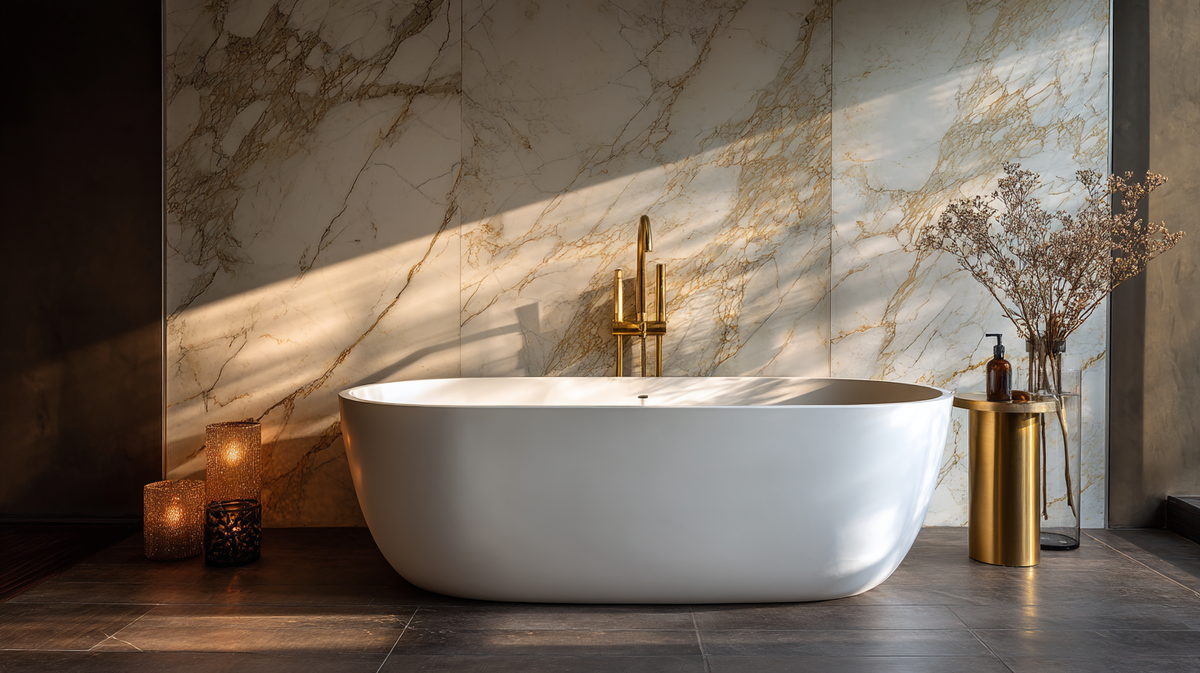
A primary bath with a freestanding tub typically has a feature wall behind the tub. Porcelain slab cladding on that wall, full-height, book-matched if possible, creates one of the strongest 2026 architectural moments in residential. The dramatic stone-look continues from floor to ceiling without visual interruption.
Fireplace surrounds
The porcelain slab fireplace surround is becoming the contemporary alternative to traditional stone or stacked-stone surrounds (see our fireplace surrounds guide). The slab provides the dramatic stone-look at full height; the engineered material handles the thermal cycling that fireplaces produce; the install is meaningfully simpler than thin-veneer stone.
Waterfall islands continuing to the floor
A waterfall island where the counter slab continues vertically down the cabinet end is a 2026 contemporary signature. Porcelain slab works especially well for waterfall details because the lighter weight makes the install more straightforward and the bookmatched veining can be carried through the corner without the cutting-pattern challenges of natural stone.
Kitchen full-height backsplashes
Running porcelain slab from counter to ceiling, same colorway as the counter, no grout joints, eliminates the backsplash as a separate design element. The kitchen reads as a continuous slab surface from horizontal to vertical, with the cabinetry the only material break.
Statement walls in living and entertainment spaces
Single feature walls in living rooms, perhaps behind a built-in entertainment center or as a backdrop to a furniture grouping, are increasingly specified in porcelain slab cladding. The stone-look reads premium, the slab format eliminates joint patterns, and the durable surface handles incidental contact better than alternatives.
Substrate, Adhesive, and Slab Weight
The technical considerations matter meaningfully. A successful porcelain slab cladding install depends on three things working together.
Substrate. The wall behind the slab must be flat, structural, and properly prepared. Cementitious backer board over wood or metal studs is standard for residential wet-area applications. Concrete masonry walls are acceptable. Drywall alone is not adequate, the slab weight (a 60×120 inch 6mm slab weighs roughly 70 pounds) requires structural support beyond drywall fastening.
Substrate flatness is critical. Porcelain slabs are dimensionally precise but rigid; the wall behind them must be flat within 1/8 inch over 10 feet. Wavy substrates produce stressed slabs that can crack.
Adhesive. Porcelain slab cladding uses specialized polymer-modified thin-set adhesives engineered specifically for large-format porcelain. Standard tile thin-set is not adequate, the dimensional behavior is different, and standard products can produce delamination over years.
Slab handling. The slab itself is fragile during transport and install. A 6mm slab can crack from flexing during handling; rigid handling frames are required for transport. Two-person minimum for install; experienced installers use four-handle suction-cup frames for slab placement.
Bookmatching, Veining, and Pattern Continuity
Porcelain slab cladding's strongest visual move is bookmatching, placing two slabs side by side with the veining mirrored across the seam, creating a single dramatic visual. Because porcelain is digitally printed, manufacturers produce intentionally bookmatched pairs where the patterns mirror cleanly. With natural stone, bookmatching depends on slab cutting; with porcelain, it's designed.
For full-height feature walls, specifying bookmatched slabs delivers the kind of dramatic visual that historically only required quarrying and cutting natural marble. The cost differential is meaningful, porcelain bookmatched pairs are dramatically less expensive than natural marble bookmatched pairs of equivalent visual drama.
Slab Cladding vs Wall Tile
The decision between porcelain slab cladding and large-format wall tile turns on a few specific questions.
Visual continuity. Slab cladding eliminates joint patterns. Wall tile, even at large format (12×24, 24×48), produces visible joints that interrupt the visual flow.
Maintenance. Fewer joints means dramatically less cleaning, particularly in shower applications. Slab cladding reduces grout maintenance by 95%+ vs traditional tile.
Installation complexity. Slab cladding requires specialized installers and rigid handling; standard tile is broadly accessible.
Cost. Slab cladding is more expensive per square foot at material; the install labor is meaningfully higher than tile. But the result is uniquely dramatic in ways tile can't replicate.
For projects where the visual continuity matters most, slab cladding wins. For projects where standard wall surfaces are adequate, tile is the right answer. We cover the broader wall-tile question in our wall tile and backsplash guide.
The Visual Range
The porcelain slab collection covers the full residential cladding visual range:
- Marble-look (Calacatta, Carrara, Statuario, Crema Marfil), the classical range, with veining drama varying by colorway
- Quartzite-look (Calacatta Quartzite, Patagonia, Azul Macaubas), dramatic colored veining patterns
- Travertine-look, warm cream and walnut tones
- Concrete-look, the contemporary industrial range, in warm graphite and warm cream tones
- Solid colors, warm cream, deep graphite, true black
- Specialty patterns, dramatic veined patterns, board-formed concrete looks, contemporary design colorways without natural-material reference
For the comparative read against natural materials, see our sintered stone vs natural quartzite guide.
Where It Lands Wrong
Three specific situations where porcelain slab cladding doesn't fit.
Tight spaces with complex geometry. Slab cladding wants planar walls. Small bathrooms with multiple corners, niches, and irregular geometry are better-served by tile, which forgives the geometry.
Buyers who specifically want natural material. Porcelain at any quality level is engineered material; for buyers who specifically value the natural-stone-as-design-element argument, marble or quartzite cladding is the right answer despite the higher cost.
Heavy-textured architectural language. Slab cladding reads smooth and contemporary. In architectures that want heavy material texture (mountain modern, traditional, rustic), stacked stone veneer or other textured material reads more correctly.
Where to Start
Specifying porcelain slab cladding starts with the room, which surface in which room is meant to be the architectural feature, and would it benefit from continuous slab rather than tile? From there, the colorway and the substrate preparation follow. Browse the porcelain slab collection for the cladding-rated products, and see related guides at porcelain slab countertops, wall tile and backsplash, and fireplace surrounds. For the broader slab decision framework, our slab buyer's guide pillar.
To take this from reading to ordering, browse countertops and slabs and run your measurements through the countertop and slab calculator.