Buyer Guide
Porcelain Slab Countertops: Large Format, Honest Spec
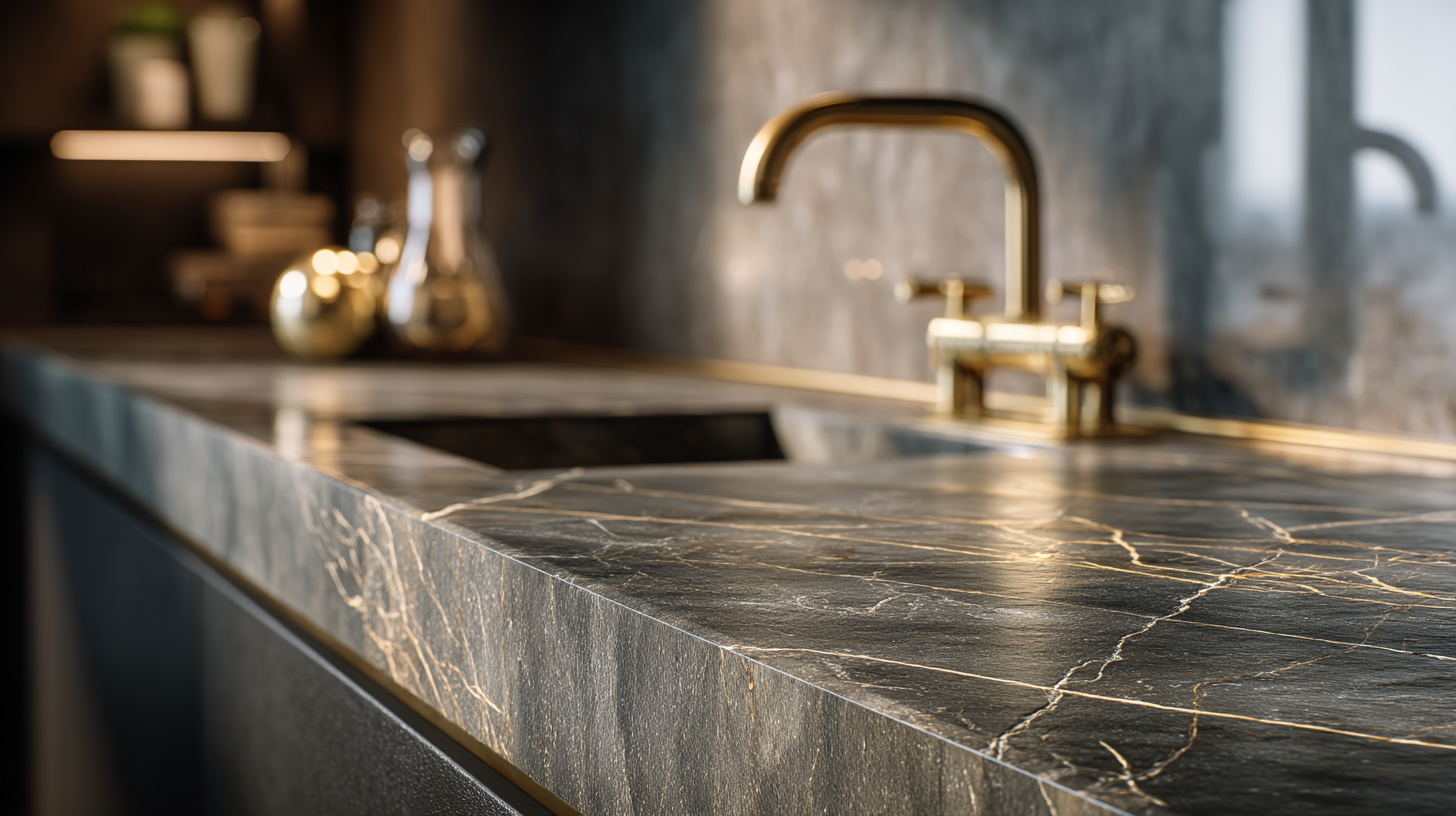
Porcelain slab as countertop material is a 2026 conversation that's still under-told in residential. The product has been used at the high-end European architectural level for over a decade, and at the contract and hospitality level for nearly as long, but residential buyers are usually told their counter choices are quartz, granite, marble, quartzite, and butcher block. Porcelain slab, large-format, ultra-thin, dramatically veined or quietly solid, and meaningfully more durable than most of the alternatives, is the option that doesn't make the standard four-way conversation.
This guide reads porcelain slab honestly. What it actually is, where it earns the specification over the alternatives, where the install gets technical, and how the residential applications are evolving in 2026.
What a Porcelain Slab Actually Is
A porcelain slab is a single very large sheet of vitrified porcelain, typically 60×120 inches (10 feet by 5 feet) or 63×126, produced under extreme pressure (over 15,000 PSI in some manufacturing processes) and fired at temperatures above 2,000°F. The result is an exceptionally dense, non-porous, extremely hard surface that handles heat, scratching, staining, and impact at a level no other countertop material matches.
Three thicknesses are commonly specified:
6mm porcelain, typically used as wall cladding or as a thin overlay on existing countertops. Too thin for unsupported countertop spans.
12mm porcelain, the standard countertop thickness for most residential applications. Lighter than 3cm stone, easier to ship and handle, plenty strong for typical island and perimeter spans.
20mm and 30mm porcelain, heavier-duty thicknesses used for outdoor counters, high-traffic commercial applications, or projects that want the visual weight of a thicker slab edge.
The porcelain slab collection carries the residential thicknesses. For the heavier outdoor applications, see also the glazed porcelain slabs.
The Material Properties That Justify the Specification
Hardness: Porcelain slab measures 7 to 8 on the Mohs scale, harder than quartz and meaningfully harder than marble. Knives don't scratch it. Heavy ceramic crockery doesn't damage it. The surface is essentially scratch-immune in normal residential use.
Heat resistance: Porcelain is fired at over 2,000°F; nothing in a residential kitchen touches that. A hot pan straight from the cooktop placed on porcelain leaves no mark and risks no thermal stress to the slab. This is the only countertop material that genuinely earns the "no trivet needed" claim, though we still recommend trivets as a habit, mostly because they protect the pan.
Stain resistance: Vitrified porcelain has a water absorption rate below 0.1%. Wine, coffee, oil, beet juice, none of it penetrates the surface. A spill wipes off with water; even hours later, there's no stain to address.
UV stability: Porcelain doesn't fade or yellow in sunlight. This makes it the right call for kitchens with strong south or west exposure where some natural stones will shift tone over years.
Outdoor performance: The same properties that make porcelain right indoors make it the only countertop material genuinely engineered for outdoor kitchens. Freeze-thaw, UV, wind-driven rain, none of it bothers porcelain.
The Visual Range
Porcelain's visual range covers the full residential vocabulary, with one important honest caveat: porcelain is printed and digitally rendered to imitate other materials. A "marble-look" porcelain slab is genuinely visually convincing at viewing distance, large-format digital printing has reached the point where the veining reads as natural at six feet, but it isn't marble, and on close inspection it never quite reads as the source material does. The repeat pattern of the printing is essentially invisible in 2026 high-end porcelain, but the depth of veining, the way light moves through the stone, the small irregularities of the natural product. Those don't fully transfer.
The right way to read this: porcelain slab earns the specification when its specific properties (hardness, heat, outdoor, scale) matter more to the project than the absolute authenticity of the natural-material reference. For a kitchen counter that gets daily heavy use, that math often favors porcelain. For a fireplace surround that won't see use but will be looked at constantly, marble might still win.
Beyond the natural-stone imitations, porcelain slab also covers solid colors (warm cream, deep graphite, true black), concrete-look textures, and contemporary patterns that have no natural-material equivalent. These are the colorways where porcelain earns the specification on its own terms rather than as a marble alternative.
Edge Profiles
Porcelain slab takes the same edge profiles as natural stone, with one technical difference: the slab is thinner (12mm) than typical 3cm natural stone, so most porcelain edges are mitered and laminated to read as if they were 3cm or 6cm thick. The lamination is invisible when done well, the slab face is folded over the cabinet edge and joined at a 45-degree miter, and the joint disappears with proper fabrication.
Eased edge, micro-bevel, contemporary default, the cleanest read.
Mitered apron, the edge slab is laminated to read as a thicker counter (typically 4cm or 6cm), giving visual weight without slab weight. The standard for mitered porcelain.
Waterfall edge, the slab continues vertically down the cabinet end, reading as a continuous folded plane. Porcelain is exceptionally well-suited to waterfall details because the lighter weight makes the install easier and the bookmatched veining can be carried through the corner.
Bookmatching and Veining Continuity
One of porcelain's strongest applications is bookmatching, placing two slabs side by side with the veining mirrored across the seam, creating a single dramatic visual. Because porcelain is digitally printed, manufacturers can produce intentionally bookmatched slab pairs where the patterns are designed to mirror cleanly. With natural stone, bookmatching depends on how the slabs were cut from the block, and only certain colorways and certain block orientations produce true book-matches.
This is one of the cases where porcelain's "engineered" nature is a feature rather than a compromise, the bookmatching is more reliable, more dramatic, and more economically accessible than with natural marble.
Installation: What Changes vs Natural Stone
Three technical differences from natural-stone install.
First, the slab is lighter, a 12mm porcelain slab weighs about half what a 3cm stone slab does. That makes shipping, handling, and install easier, but it also means the substrate matters more. The cabinet platform under porcelain wants to be flatter and more rigid than natural stone tolerates; small cabinet height irregularities that natural stone forgives can crack porcelain.
Second, porcelain wants a fabricator with specific experience. The mitering, the cutting (porcelain demands water-cooled diamond blades and slow feed rates), and the seam treatment are all different from stone fabrication. A general stone shop will often quote a porcelain job, but the install quality varies dramatically by experience. Work with fabricators who specialize.
Third, the seams. Porcelain seams are typically tight and dyed-color-matched epoxy rather than the visible silicone or grout of stone. A well-executed porcelain seam is essentially invisible. A poorly executed one is the most visible flaw in the install.
Pairing Porcelain Slab with the Rest of the Kitchen
Porcelain's visual quietness, even the dramatic-vein products read more even-toned than natural marble, pairs especially well with cabinetry that wants to read as the architecture. Frameless flat-front cabinets in warm matte taupe or oak carry the kitchen's character; the porcelain counter is the clean horizontal surface that holds them. See our cabinet decision tree for the cabinet pairing question.
For backsplash, porcelain slab can run as a continuous full-height piece, same colorway as the counter, no grout joint, the most contemporary read available. We cover full-height porcelain slab cladding in our porcelain slab wall cladding 2026 guide.
Outdoor Kitchens
The single application where porcelain slab is genuinely without rival. Outdoor counters take UV, freeze-thaw, weather, and the kind of tool-use that indoor counters don't see. Porcelain handles all of it; natural stone, quartz, and most quartzites don't survive 5 years of outdoor exposure without visible degradation. We cover the outdoor kitchen material question in our outdoor kitchen materials guide.
Where to Start
Specifying porcelain slab starts with the slab itself, same as quartzite, the specific slab is what you're buying. Browse the porcelain slab collection and the broader countertops and slabs library for the curated set. For comparative reads against the alternatives, see our slab buyer's guide pillar and the sintered stone vs quartzite piece for the material-science breakdown.
Ready to compare in person? Browse countertops and slabs at Citadel Spaces, and use the countertop and slab calculator to turn room dimensions into an order quantity.