Buyer Guide
Outdoor Tile, the Complete Guide: 77 Colorways for Patios, Walkways & Pool Decks
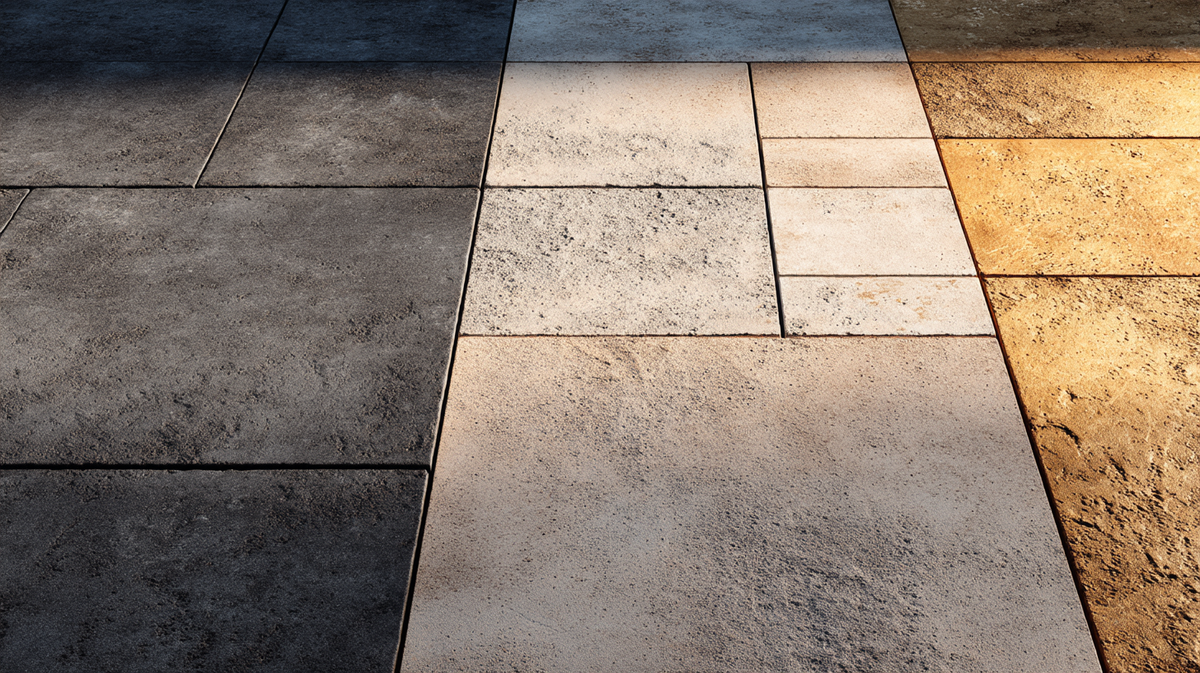
Outdoor tile sits at a useful intersection in the outdoor surface conversation. Pavers (typically 20mm) are the standard for pedestal-set, sand-set, and mortar-set outdoor floor systems. Outdoor tile (typically 10mm) is the same colorway and finish family in a thinner profile, designed for adhered installation over engineered concrete sub-slabs, vertical surfaces, and the indoor-outdoor continuity moment where tile runs from a covered patio out to an open deck without a visual break.
The 77 SKUs in Citadel's outdoor tile collection cover the full residential and light-commercial range. This guide explains where outdoor tile earns the specification over pavers, the slip and freeze-thaw considerations that make a tile actually outdoor-rated, and how the indoor-outdoor continuity story is shaping 2026 specifications.
Outdoor Tile vs Outdoor Pavers: The Distinction That Matters
Both materials are vitrified porcelain. The difference is thickness and intended install method.
Outdoor pavers at 20mm are designed to be self-supporting on pedestal or sand-set systems, the paver itself spans the load, with the substrate just providing a level reference. Pavers work over uneven ground, over rooftop assemblies, over engineered drainage layers.
Outdoor tile at 10mm is designed for thin-set adhered installation over a continuous, structural sub-slab. The tile doesn't span anything; it's a finish layer on top of a slab. Outdoor tile won't survive on pedestals or sand-set; the slab below it does the structural work.
The same colorway is often available in both formats. A project that runs a pedestal-set rooftop deck transitioning into a covered indoor space might use 20mm Arterra pavers on the deck and the matched 10mm tile in the indoor space, with the pattern and color carrying continuously across the transition.
The Slip-Resistance Question
Outdoor tile and outdoor pavers have to handle wet conditions, rain, pool splash, irrigation, dew. Slip resistance is rated by two systems:
DCOF (Dynamic Coefficient of Friction), the U.S. residential standard. A wet DCOF reading of 0.42 or above is considered acceptable for residential wet-area installations.
R-rating, the European system. R9 is interior dry, R10 is interior wet, R11 is outdoor general use, R12 is outdoor wet (pool decks, exterior stairs), R13 is industrial wet.
For residential outdoor applications, look for R11 minimum. For pool decks and any outdoor stair tread, R12 is the right specification. The tile texture that delivers R12 typically reads as a deliberate surface relief, a subtle stone-cleft texture, a slate-cleft pattern, or a sandblasted finish. Smooth honed tiles don't earn R12 ratings; they're not appropriate for unprotected outdoor use. Our DCOF and R-rating guide covers the full ratings vocabulary.
Freeze-Thaw Behavior
The other critical outdoor specification is water absorption. The American National Standards Institute defines outdoor-rated porcelain as having less than 0.5% water absorption. At that threshold, water doesn't enter the tile body in volumes that, when frozen, can crack the surface.
Quality outdoor porcelain runs well below the threshold, Arterra's published rate is below 0.05%, an order of magnitude below the standard. In freeze-thaw climates, this is the difference between a 30-year deck and a 10-year deck. Don't accept "outdoor-rated" alone as a specification; verify the absorption rate.
The 77-SKU Library
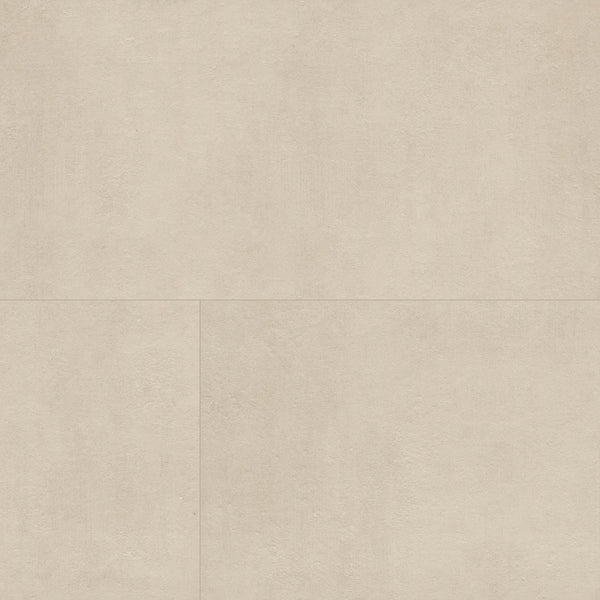
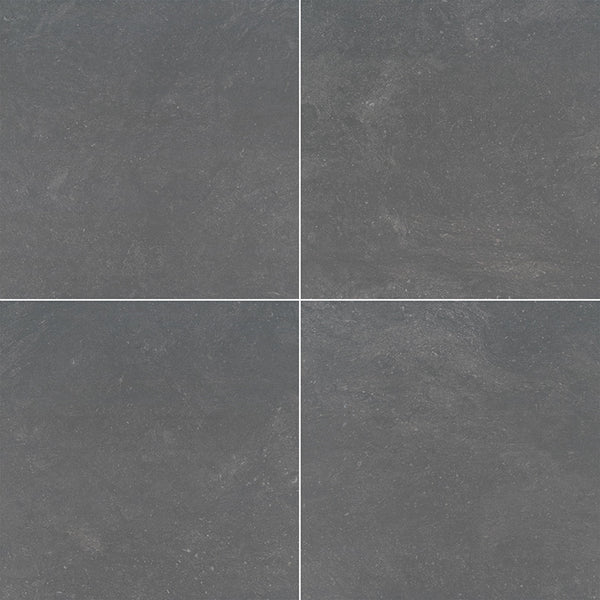
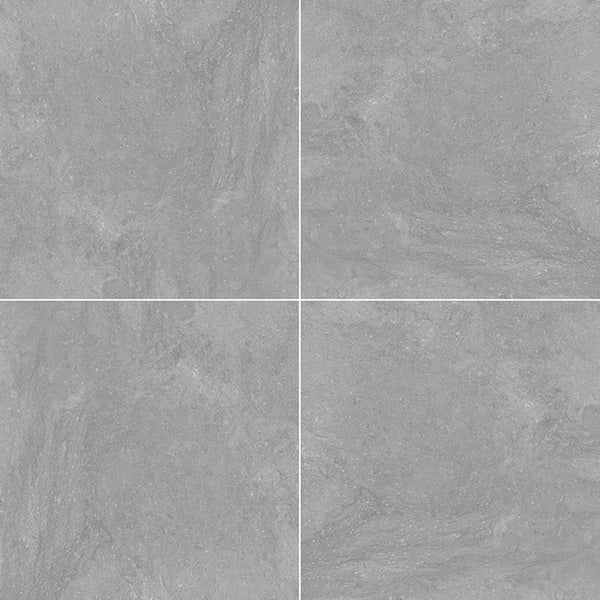
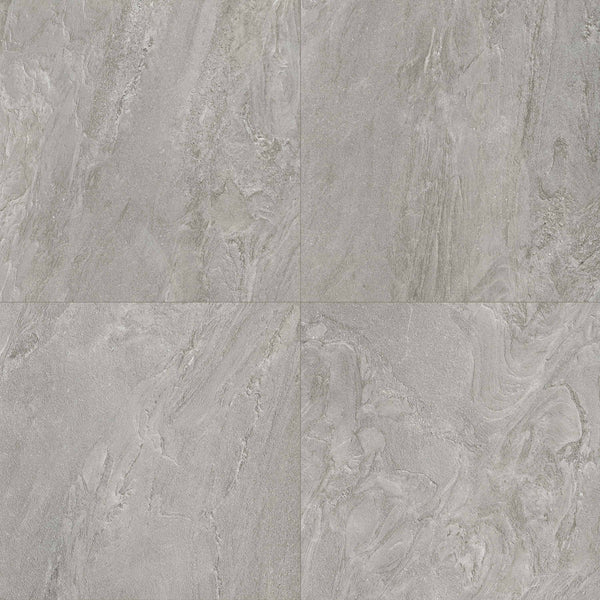
The library covers four tonal families. Browse the full outdoor tile collection for the visual context.
Warm cream and travertine reads
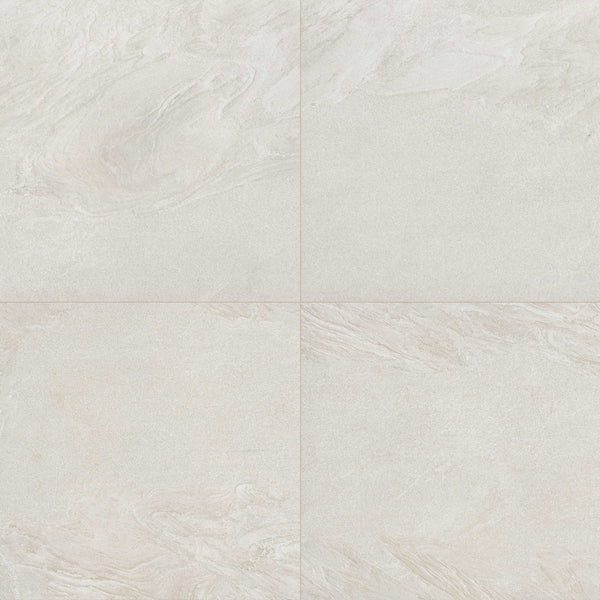
The largest tonal group, honed travertine looks, warm limestone reads, soft-cream solids. These dominate residential pool decks and Mediterranean-modern patios.
Honed graphite and slate
Cleft slate textures, honed graphite stones, warm-charcoal contemporary reads. The contemporary-residential default for modern architecture and minimalist outdoor spaces.
Wood-look outdoor porcelain
Plank-format porcelain tile printed and textured to read as weathered teak, ipe, or oak. For outdoor decks where the visual want is wood but the performance need is porcelain (zero rot, no sealing, no replacement). One of the fastest-growing categories, see our indoor-outdoor continuity guide. (That post is in queue; meanwhile see 2026 outdoor trends.)
Concrete-look
Board-formed concrete textures, polished concrete looks, raw industrial reads. Architectural and contemporary.
Where Outdoor Tile Earns the Specification
Covered patios and outdoor rooms
The classic application, a covered loggia or three-walled outdoor room with engineered concrete slab gets outdoor tile run over it, treated essentially as an exterior version of an interior space. The 10mm tile reads cleaner than 20mm pavers in this context because the visual scale matches indoor expectations.
Indoor-outdoor continuity
The strongest 2026 application. A kitchen runs out to a covered patio, the same tile, same colorway, runs from the kitchen interior continuously through the threshold and onto the patio. The doorway disappears as a visual break; the room reads as one continuous volume that happens to have weather on one side. This is where outdoor tile genuinely outperforms pavers, because the matched indoor-outdoor system uses thin tile inside (over the indoor sub-slab) and matched paver outside (over a pedestal or sand-set deck), same color, same finish, same surface reading.
Vertical exterior cladding
Outdoor tile also runs vertically, exterior accent walls, planter walls, water-feature cladding. The thinner format and standard adhered install method makes vertical work straightforward.
Pool surrounds (with slab below)
For pool decks built over an engineered concrete sub-slab, outdoor tile is the right finish. For pool decks built on pedestal or sand-set systems, you want pavers, not tile.
The Indoor-Outdoor Continuity Story
The single most-requested 2026 outdoor design move: a continuous floor running from kitchen to patio, with no visible threshold, no material change, no break. The execution requires four things working together:
First, a pivot or sliding glass door system that pockets fully into the wall, leaving no track or visible threshold when open.
Second, matched indoor and outdoor flooring, same color, same finish, same texture, ideally same product family in the two thicknesses (interior 10mm tile, exterior 20mm paver where the deck is built outside the slab).
Third, a properly detailed threshold drainage strategy, the doorway has to handle rain that blows in when the door is open, with a hidden trench drain or graded slope that pulls water away from the interior.
Fourth, a designed transition that's invisible when the door is closed. The interior tile runs to within ¼ inch of the threshold; the exterior paver picks up at the same elevation on the other side. The eye reads continuity.
This is one of the strongest design moves available in 2026 residential outdoor design and one of the fastest ways to make a kitchen feel substantially larger than its actual square footage. The outdoor tile collection and porcelain paver collection carry the matched product families that make it possible.
Specification: The Five Things to Verify
Before committing to an outdoor tile specification, verify these five details:
- Slip rating: R11 minimum, R12 for pool/stairs, or DCOF ≥ 0.42 wet.
- Water absorption: below 0.5%, ideally below 0.1% for freeze-thaw climates.
- Edge type: rectified for clean joint reads; non-rectified is acceptable but reads more rustic.
- Substrate compatibility: the manufacturer's recommended setting bed and adhesive system, and confirmation your installer has experience with that system.
- Matched paver availability: if indoor-outdoor continuity is part of the design, verify the paver in the matched colorway is available before specifying the tile.
Where to Start
Specifying outdoor tile starts with the install method, adhered over slab (tile) or pedestal/sand-set (paver), because that decides which catalog you're shopping. From there, climate (freeze-thaw or hot-only) and use (pool, walkway, covered patio, indoor-outdoor continuity) drive the tonal and textural choice. Browse the full outdoor tile collection alongside the porcelain paver library for matched indoor-outdoor systems. For the broader paver-vs-stone decision, see our porcelain vs natural stone pavers guide.
Ready to compare in person? Browse hardscapes and turf at Citadel Spaces, and use the flooring and tile coverage calculator to turn room dimensions into an order quantity.
From the guide
Shop the pavers in this guide