Buyer Guide
The Quietest Floors: Acoustic Performance of Premium Surfaces

Floor acoustics is one of the most underweighted residential specifications. Buyers obsess over visual character, durability, and patina trajectory; sound performance, how the floor sounds when walked on, how much sound it transmits to rooms below, how reverberant the room feels acoustically, gets specified almost by accident. The result is homes where one floor decision creates years of unwanted noise downstairs, or rooms where conversation reverberates uncomfortably.
This guide treats acoustic performance as a primary specification dimension. Which floors actually live quietly, what underlayment specifications matter, how the rest of the room's materials interact with floor acoustics, and which rooms specifically benefit from acoustic-focused specification.
The Two Acoustic Dimensions
Floor acoustics breaks into two distinct dimensions that get conflated.
Footfall sound, the sound of feet, dragged objects, and impacts on the floor as heard within the same room. Affects how the room "sounds" to its occupants. Important for any room where conversation, music, or quiet activity happens.
Sound transmission, the sound transferred through the floor structure to rooms below. Affects how much noise from the upper floor reaches lower-floor occupants. Important for any multi-story residential, particularly bedrooms over living areas or apartments with neighbors below.
Different specifications affect each dimension. Hard surfaces transmit sound efficiently downward; soft surfaces absorb in-room sound. Some materials handle both well; others handle one and ignore the other.
Material Acoustic Behavior
Hardwood
Hardwood is acoustically reflective (footfalls audible, conversation reverberant) and transmits sound efficiently downward. The natural specification is appropriate for ground-floor and single-story applications; upper-floor hardwood requires specific underlayment to manage transmission.
Within hardwood, engineered hardwood with attached cork backing performs better than solid hardwood without underlayment for sound transmission. See the hardwood collection.
Standard LVT
Standard luxury vinyl tile is a moderate acoustic performer. The vinyl construction has some natural sound damping; attached underlayment improves performance further. Both footfall and transmission handle better than hardwood without underlayment but worse than carpet.
WPC (Wood Plastic Composite)
WPC's wood-flour content provides slightly better acoustic damping than standard LVT. Footfall reads warmer and quieter; transmission to floors below is somewhat reduced. The premium Nove Plus and Nove Reserve tiers (see our Nove curator guide) have appropriate acoustic specifications for residential use.
SPC (Stone Plastic Composite)
SPC's stone-mineral core makes it harder and more acoustically reflective than WPC. Footfall reads firmer; transmission to floors below is slightly more pronounced. SPC is appropriate for ground-floor applications where dimensional stability matters; for upper-floor applications where acoustic performance matters most, WPC is often the better answer.
Tile and stone
Hard surfaces, ceramic tile, porcelain tile, natural stone, are acoustically reflective and transmit sound efficiently. Most acoustically problematic of the major floor categories. Best applications: ground-floor wet-area applications where the trade-off is acceptable; bathroom and kitchen contexts where extended quiet conversation is rare.
Tile floors in upper-floor applications produce significant noise transmission and require careful underlayment plus consideration of the rooms below.
Carpet
The strongest acoustic performer, absorbs both footfall and transmission. Largely out of premium residential specification due to maintenance, allergens, and aesthetic preferences. Where acoustic performance is critical and visual is acceptable, carpet remains the best answer.
Underlayment Specifications
The underlayment beneath the floor finish materially affects acoustic performance. Three categories matter for residential.
Cork underlayment
Natural cork in 3-12mm thickness. Excellent acoustic absorption, particularly for footfall sound. Strong specification under hardwood and engineered wood floors. Cork also provides some thermal insulation and dimensional stability.
Foam underlayment
Polymer foam in various densities. Standard with most rigid core flooring (often attached to the plank backing). Adequate acoustic performance for most residential applications.
Acoustic mat systems
Specialized rubber or polymer mats engineered specifically for sound transmission reduction. Premium specification for upper-floor residential where transmission to rooms below is critical. Significantly more effective than standard foam underlayment for transmission specifically.
Acoustic Performance Ratings
Two ratings appear on flooring spec sheets.
STC (Sound Transmission Class), measures airborne sound transmission. Higher is better. Residential code typically requires STC 50; quality acoustic floors achieve STC 55-65.
IIC (Impact Insulation Class), measures impact sound transmission (footfalls, dropped objects). Higher is better. Residential code typically requires IIC 50; quality acoustic floors achieve IIC 55-70.
For upper-floor residential applications, specify floors and underlayments with combined ratings meeting or exceeding STC 55 / IIC 55. The combination dramatically reduces noise reaching the floor below.
The Room's Acoustic Context
Floor acoustics interact with the rest of the room's acoustic environment.
Hard reflective rooms (tile floor, painted drywall walls, painted ceiling, hardwood furniture, no rugs) reverberate strongly. Conversation echoes; the room reads acoustically active.
Soft absorptive rooms (carpet or rug, upholstered furniture, fabric window treatments, acoustic ceiling) absorb sound. Conversation reads close and direct; the room reads acoustically calm.
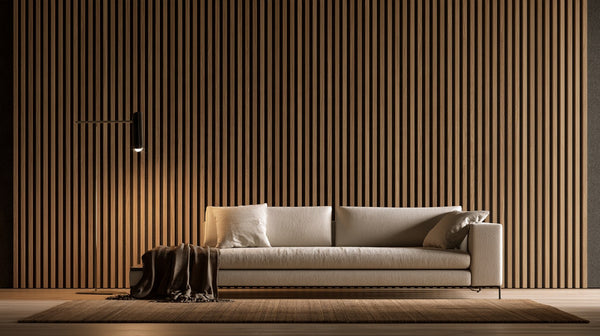
For rooms where acoustic performance matters (bedrooms, libraries, home offices, dining rooms), the room should be acoustically softened beyond just the floor. Adding rugs to hard floors, upholstered furniture, fabric window treatments, and (if budget allows) acoustic wall panels meaningfully improves the room's acoustic character.
Specific Room Recommendations
Bedrooms
Acoustic performance is the primary driver. Specify hardwood or premium WPC with attached underlayment, plus large area rugs, upholstered headboards, fabric window treatments. The bedroom should read as acoustically soft.
Living rooms
Variable use modes (conversation, media, daytime activity). Hardwood or premium WPC works well; large rugs and upholstered furniture handle the soft layer. Avoid: tile floors with no rugs (excessive reverberation).
Home offices
Quiet conversation and concentration matter. Specify the same as bedrooms, hardwood/WPC plus rugs and soft furnishings. Particularly important if the office hosts video calls (echoey rooms read poorly on calls).
Kitchens
Acoustic performance less critical because most activity is loud anyway. Tile or hard floor acceptable. Acoustic ceiling treatments can help if the room is open-plan with adjacent quieter spaces.
Bathrooms
Tile and stone are appropriate despite reflective acoustics. Quick conversational use; reverb is not a meaningful concern.
Open-plan main living areas
The most challenging acoustic specification. Hardwood or premium LVT throughout, with strategic large rugs in conversation zones, upholstered furniture, and consideration of acoustic ceiling treatment in particularly large or particularly active rooms.
Multi-Story Considerations
Upper-floor flooring choice meaningfully affects rooms below.
Bedrooms over living rooms (apartments and multi-story homes): nighttime walking on the upper floor disturbs lower-floor occupants. Specifications that minimize this: WPC with high-IIC underlayment, soft area rugs in walking paths, attention to overall acoustic specification of the upper floor.
Living rooms over bedrooms: similar concern in reverse. The active living room above can disturb sleeping occupants below. Same specification approach plus consideration of timing (which rooms are above which).
Kitchens over any quiet space: kitchens generate significant impact noise (dropped objects, walking, dragged furniture). Hard tile floors transmit dramatically; consider warm-tone WPC or hardwood with appropriate underlayment instead, or relocate the kitchen architecturally.
The HVAC and Mechanical Background
One often-overlooked acoustic factor: the HVAC system's continuous background noise. Modern systems can run essentially silent; older or improperly-specified systems produce constant low-level drone that affects perceived room acoustics.
Specifications that improve mechanical acoustics:
- Variable-speed HVAC equipment that runs at lower speeds for longer periods (rather than full-blast cycling)
- Properly-sized ductwork (oversized ducts reduce velocity and noise)
- Sound-rated diffusers and grilles
- Mechanical equipment located away from quiet zones (not adjacent to bedrooms)
Where to Start
For projects with acoustic performance as a meaningful concern, the right starting decisions: hardwood or premium WPC (rather than tile) in bedrooms and living areas, attached or specified underlayment with high IIC ratings for upper-floor applications, large area rugs in conversation zones, and overall room treatment with soft furnishings and fabric window treatments. Browse hardwood, luxury vinyl flooring (particularly the WPC-construction Nove Plus and Reserve tiers), and rigid core for the floor materials. For broader floor specification context, our flooring decision pillar, Nove curator guide, and rigid core flooring guide.
When the choice is made, browse luxury vinyl plank and size the order with the flooring and tile coverage calculator.
From the guide
Shop the floors in this guide